

After a quarter-century of work, Violet Oakley made her final mark on the Pennsylvania Capitol.
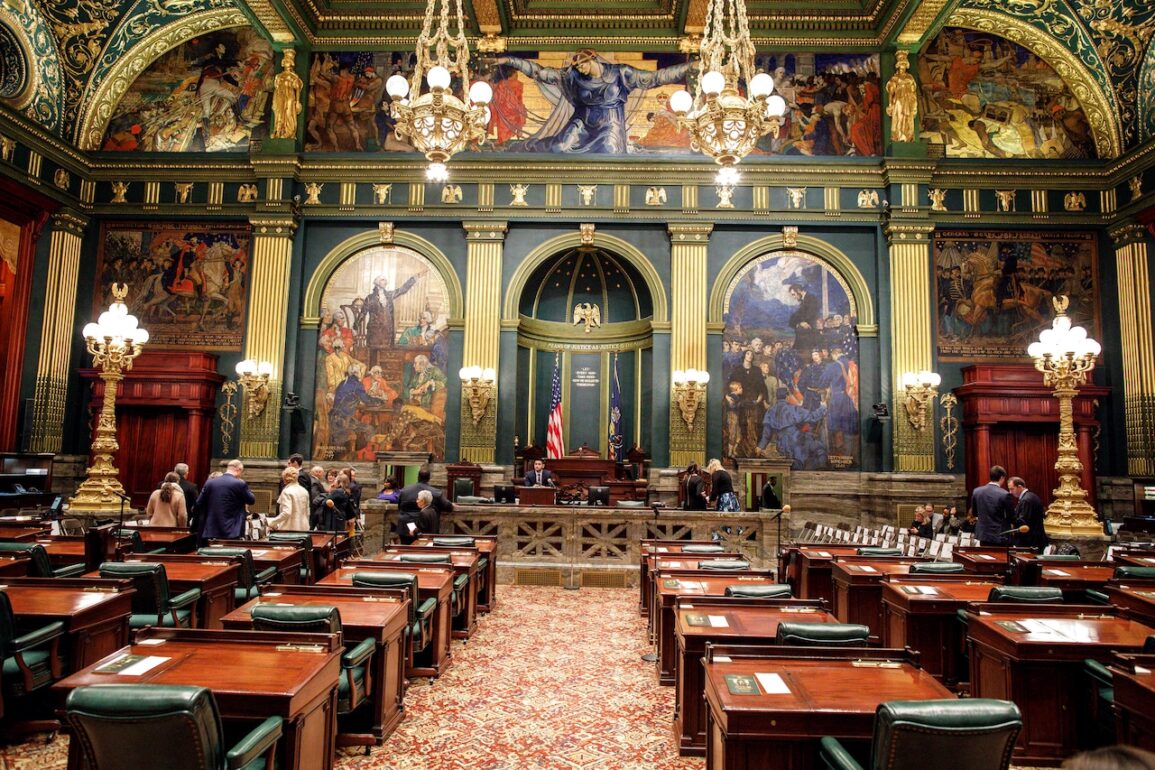
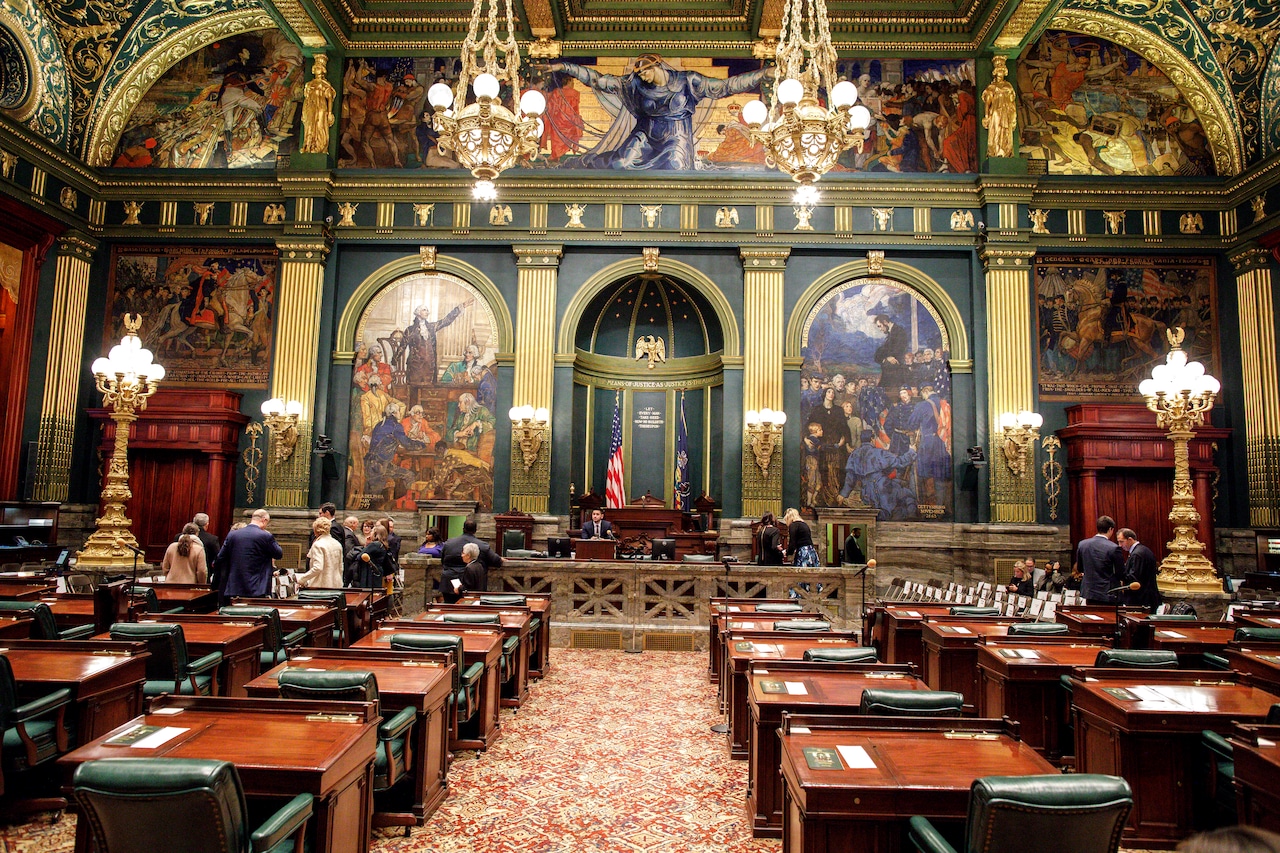
The Philadelphia artist, the chief muralist at the Capitol, unveiled 16 paintings in the Supreme Court Room in May 1927.
The murals represented pages of an illuminated manuscript on the development of law.
“A building such as this without paintings would be like a finely featured face devoid of expression,” former U.S. Sen. George Wharton Pepper said during the ceremony. “These paintings give a new expression of countenance to the Capitol.”
For Oakley, the 43 murals she painted in the Capitol Complex over 25 years were more than mere decoration. Through them, she was advancing themes of religious tolerance, racial equality and world peace, consistent with William Penn’s Quaker political principles.
Much changed in Pennsylvania and America in those 25 years. To take one significant example, when Oakley painted her first murals at the Capitol, women didn’t have the right to vote. By the time she unveiled her Supreme Court paintings, the 19th Amendment guaranteed that they could.
In 1902, Joseph M. Huston, the architect in charge of designing a new state Capitol after the building burned down in 1897, selected Oakley to paint murals in the Governor’s Reception Room. Thus, she became the first woman to receive a government mural commission in the United States.
“Though it was not known at the time,” the Pennsylvania Capitol Preservation Committee says on its website, “Oakley would become the principal artist for the largest amount of murals in the Pennsylvania Capitol.”
When the Capitol’s main muralist, Edwin Austin Abbey, died in 1911, Oakley was chosen to complete his commission to paint murals in the Senate chamber and Supreme Court Room.
“No woman in America,” The New York Times reported, “has ever held a place that approaches the place she holds in decorative art.”
This year marks the 150th anniversary of this pioneering artist’s birth. The following is my interview with Patricia Likos Ricci, an authority on Oakley and a professor of art history at Elizabethtown College, on the artist and her legacy.
You’ve written that a female muralist like Oakley was an “anomaly” in the early 20th century. Why was this the case?
At the beginning of the 20th century, mural painting in government buildings was a prestigious branch of art practiced entirely by men. The vast scale of the murals entailed physical labor at a level thought to be beyond the capacities of women artists who typically produced easel paintings and illustrations.
Designing civic murals was also intellectually demanding and required historical research to accurately portray individuals and events. Since women were virtually excluded from the political process and could not even vote, architects assumed they were incapable of composing civic mural themes.
But when Capitol architect Joseph M. Huston saw Violet Oakley’s stunning mural of the “Heavenly Host” in All Angels Church in New York, her artistic ability alone convinced him to hire her as “an encouragement of the women of the state.” Huston’s willingness to break ranks made headlines and made Oakley famous as the first woman to receive a government mural commission.
How would you describe Oakley’s style?
Oakley adapted visual techniques from her prior experience as a stained-glass designer and illustrator. She outlined figures with black, like the lead lines in a stained-glass window, and painted them in with vibrant color that made the images legible from a distance. She captioned her murals like illustrations with inscriptions artfully inserted on banners, scrolls and borders.
Oakley painted each of the three Capitol chambers in a different historical style. In the Governor’s Reception Room, she composed the murals as a series of English historical tableaux.
In the Senate chamber, she reconfigured the traditions of Italian Renaissance art to express American ideals. For example, she framed scenes of virtuous Quaker colonists in gilded Renaissance-style altarpieces like saints.
In the Supreme Court Room, she treated the wall panels as a sequence of pages in an illuminated manuscript on the history of the law and inscribed them with calligraphy and Celtic-style borders.
What was Oakley seeking to communicate in her Pennsylvania Capitol murals?
Oakley wanted to communicate the enduring value of William Penn’s political principles. In the Governor’s Reception Room, she chronicled the persecutions of Quakers and other dissenters in England that drove Penn to establish his province on the principle of religious tolerance. In the Senate chamber, she depicted the Quaker practice of nonviolence toward Native Americans and their efforts to abolish slavery.
To personify Penn’s belief in the God-given equality of all human beings, she created a monumental version of the Renaissance “Madonna of Mercy” uniting the peoples of the world under her blue veil.
During World War I, Oakley came across Penn’s “Plan for a Parliament of Nations” to arbitrate conflicts. In the Supreme Court Room, she showed that Penn’s idealistic belief in world government was an attainable goal by tracing the evolution of the law from states to nations to the recently established International Court of Justice at the Hague.
Why is Oakley important?
Certainly Oakley is important because she was the first woman entrusted with a mural commission for a government building. She demonstrated that excluding women from mural painting was based on a fallacy not unlike the arguments used to exclude women from voting.
But Oakley’s pictorial history on the walls of the Pennsylvania State Capitol is also important because it recognized the state’s pivotal role in addressing religious and racial prejudice. At a time when African Americans were not represented in American civic murals, she was the first to depict the slave trade.
Oakley believed that art had the power to inform and inspire, and she used that power to promote Penn’s political ideals. After completing her commission at Pennsylvania State Capitol, she became an advocate for the League of Nations and the United Nations.
Oakley was an independent thinker in her personal life as well. Early in her career, she formed a group household with the illustrators Jessie Willcox Smith and Elizabeth Shippen Green that raised their standard of living and advanced their careers. Later, she and the artist Edith Emerson, who became the director of Woodmere Art Museum, lived together as a couple for many years.
Is there anything else you would like people to know about Oakley?
The Pennsylvania State Capitol murals were only one part of Oakley’s extensive body of work. She produced murals and stained glass for churches, schools and residences, and numerous portraits and illustrations. You can see the range of Oakley’s career online at Woodmere Art Museum in Philadelphia: woodmereartmuseum.org/the-violet-oakley-experience.
For more on Oakley
Carol Buck, history curator at The State Museum of Pennsylvania and author of “Violet Oakley: American Artist, Modern Day Activist,” will discuss Oakley, Green and Smith, known as the “Red Rose Girls,” at 6 p.m. March 25 at the Historic Harrisburg Association, 1230 N. Third St., Harrisburg. The event is free. For more information, contact info@historicharrisburg.org or 717-233-4646.
Joe McClure is a news editor for The Patriot-News. Follow him on Instagram: @jmcclure5nine.
This post was originally published on this site be sure to check out more of their content