



According to the 50th Statistical Report on the Development of the Internet in China released by the China Internet Network Information Center (CNNIC) in Beijing, as of June 2022, China’s internet users numbered 1.051 billion, with 1.047 billion accessing the internet via mobile devices, accounting for 99.6% of the total internet user base. This widespread accessibility has been paralleled by continuous innovations in social media products. Features such as audio content, short videos, and live streaming have gained immense popularity, enhancing the ecosystem of social networking sites. These innovations not only meet users’ personalized demands but also significantly enrich the social media experience.The diversification of social media functions plays a dual role. Firstly, it caters to a wide range of user interests and preferences, encouraging engagement through personalized content and interactive features. This personalization fosters a sense of connection and community among users, enhancing their overall experience. Secondly, the multitude of available functions—including gaming, shopping, and social comparisons—has been shown to increase the time users spend on social media platforms. This increased engagement contributes to higher ‘stickiness’, a term used to describe users’ propensity to return to and spend time on the platform.
However, while these features can offer positive experiences, they also present potential risks. The ease of access to such a wide array of content can lead to excessive use, where the boundary between healthy engagement and problematic social media use becomes blurred. Problematic social media use, characterized by excessive concern over social media, compulsive need to access or use social media, and difficulty in disengaging, can have adverse effects on individuals’ mental health and well-being. Therefore, while the continuous innovation of social media products has undoubtedly improved the digital social landscape, it also necessitates a critical examination of how these advancements may contribute to the emergence and escalation of problematic social media use among users. Drawing from the understanding of problematic internet use, problematic social media use should be examined within a motivational framework, focusing on the underlying motives and needs of individuals, rather than solely on their behaviors [1]. Problematic social media use can be defined as an individual’s behavioral patterns on social media platforms that exceed the bounds of normal usage, leading to significant adverse effects on their social, psychological, or physical health. This usage pattern is often driven by attempts to fulfill specific psychological needs such as seeking a sense of belonging, self-affirmation, or emotional regulation. However, these attempts are achieved in counterproductive ways that can result in detrimental effects on the individual’s daily functioning and well-being. The core characteristics of problematic social media use include excessive use, emotional dependency, social impact, withdrawal symptoms, functional impairment, and persistent use. Many studies have found that problematic social media use is detrimental to students’ current and future healthy development, causing individuals to feel physiological and psychological discomfort [2]. Students with social media addictive behaviors have poor self-control [3] and are more likely to face academic difficulties [4]. Given the continuous growth and harmfulness of problematic social media use, the academic community has been focusing on the influencing factors and mechanisms of problematic social media use for many years [5]. This study aims to examine the relationship between social withdrawal and college students’ problematic social media use, focusing on the potential mediating roles of alexithymia and negative body image within this context. By doing so, it endeavors to provide empirical support for interventions addressing problematic social media behaviors among college students.
Based on Maslow’s Hierarchy of Needs Theory, Attachment Theory, and the Dual-system model of social cognition, we have constructed a theoretical model of behavior and motivation. This model seeks to explore the relationship between problematic social media use, social withdrawal, alexithymia, and negative body image. Our model begins with Maslow’s Hierarchy of Needs Theory, positing that individuals, after satisfying basic physiological needs, seek fulfillment of needs for safety, love and belonging, esteem, culminating in self-actualization [6]. In the context of contemporary social media, the pathways to satisfying these needs have evolved, particularly those for love and belonging and esteem, which are frequently pursued through online interactions. Subsequently, we incorporate Attachment Theory to explain how individuals’ attachment styles, formed from early relational experiences, influence their behavior on social media. Individuals with secure attachment may exhibit healthier social media use habits, whereas those with anxious or avoidant attachment may be more prone to problematic use. Moreover, we employ Dual-system model of social cognition to analyze how impulse control and self-regulation play roles in social media use. The interaction between System 1 (automatic, unconscious thought processes) and System 2 (conscious, logical thought processes) [7] elucidates why individuals might exhibit excessive social media use under certain circumstances.
Building on this theoretical framework, our paper aims to delve into the psychological underpinnings behind problematic social media use and analyze how social withdrawal, alexithymia, and negative body image serve as mediating variables that bridge the gap between individuals’ basic needs and problematic social media use. Social withdrawal may stem from unmet needs for belonging and insecure attachment styles, leading to difficulties in forming relationships in real life. This might push individuals towards social media as an alternative means of fulfilling their need for belonging, which may not adequately provide genuine social satisfaction, thus leading to problematic use. Alexithymia, as a barrier to understanding and expressing emotions, might be related to early attachment experiences and unmet esteem needs [8]. This barrier could leave individuals feeling helpless in the face of real-life emotional challenges, thereby seeking social media as a means of escaping reality and managing emotions, which could foster problematic use over time. The development of a negative body image might be closely linked to social comparison mechanisms on social media. Social Comparison Theory suggests that individuals tend to assess themselves through comparison with others, and social media provides a broad platform for such comparisons [9]. This continuous comparison may lead to dissatisfaction with one’s body image, thereby hindering the fulfillment of esteem needs and potentially exacerbating problematic social media use. By integrating these theories and research findings, our model aims to provide a more comprehensive perspective on the psychological roots of problematic social media use. This research emphasizes the significance of examining social withdrawal, alexithymia, and negative body image as mediating factors in order to elucidate the mechanisms through which individuals engage with social media in attempts to satisfy unmet fundamental needs, and the potential challenges encountered within this context. This understanding can help develop targeted interventions to reduce problematic social media use and promote individuals’ mental health and well-being.
In the digital age, the prevalence of social media platforms has revolutionized the way individuals fulfill their basic psychological needs, including the needs for belonging, esteem, and self-actualization, as proposed by Maslow. While these platforms offer unprecedented opportunities for social interaction, they also present unique challenges, contributing to the emergence of problematic social media use. Individuals cannot separate from the need for social interaction during the process of socialization. Interpersonal communication plays a unique role in the process of individual socialization. Social withdrawal, as one of the internalized problematic behaviors in social interactions, is manifested in the individual’s external behavioral inhibition and restraint. It also includes the lack of internal interaction motivation, a tendency towards loneliness temperament, and experiences of shyness, collectively manifesting as overall negativity, feelings of loneliness, and peer exclusion [10]. Existing research has pointed out that individuals with social withdrawal behaviors are more likely to experience poor interpersonal relationships and difficulties in social adaptation [11]. In schools, social withdrawal behaviors are significantly correlated with individual peer acceptance, peer rejection, and bullying within the class [12, 13]. The physiological symptom enhancement model suggests that social withdrawal behaviors may be related to the physiological symptoms and responses individuals experience during social interactions. These symptoms and responses might physiologically amplify the individual’s tendency to withdraw [14]. Social situations may trigger the activation of an individual’s autonomic nervous system, such as an accelerated heart rate, sweating, and trembling. These physiological responses could cause individuals to feel discomfort and tension, thereby exacerbating their social anxiety and prompting them to avoid social interactions [15]. Social withdrawal, as a significant way to alleviate social pressure, is likely to exacerbate the risk of problematic social media use. Overseas research has provided supportive evidence. Cross-sectional studies have found that social withdrawal is a risk factor inducing addictive behaviors towards social media [16,17,18]. Longitudinal studies also indicate that social withdrawal is closely related to students’ problematic behaviors [19]. Therefore, based on prior evidence, This study suggests that social withdrawal serves as a key factor associated with problematic social media use, with this relationship being mediated by the presence of alexithymia and negative body image. Social withdrawal, characterized by behavioral inhibition and a lack of motivation for real-life interactions, often stems from unfulfilled needs for belonging and poor peer relationships. Such withdrawal can lead individuals to seek out digital spaces as alternative venues for social interaction, albeit with potentially maladaptive outcomes.
In refining our discussion on alexithymia and its role in problematic social media use, it’s crucial to integrate the diverse theoretical frameworks that have explored the development of alexithymic traits. This comprehensive examination not only deepens our understanding of alexithymia but also highlights its complexity as a condition not yet fully understood within the psychological community. Alexithymia, characterized by an individual’s marked difficulty in identifying and expressing emotions, alongside a diminished imaginative capacity, encompasses challenges in recognizing subjective emotional states and a limited ability to communicate these feelings to others. This condition is seen as a significant barrier to emotional processing [20]. Investigating alexithymia through the lenses of attachment theory, psychoanalysis, and self-determination theory provides insightful perspectives into the genesis and manifestation of alexithymic traits, especially regarding social interactions and personal relationships. Attachment theory suggests that the nature of early attachment relationships significantly shapes one’s capacity for emotional processing and expression. Insecure attachments, formed during childhood, may impede emotional awareness and expression, thereby fostering the development of alexithymic traits. This linkage between attachment styles and alexithymia underscores the pivotal role of early interpersonal experiences in sculpting the emotional dimension of individuals [21]. From a psychoanalytic perspective, Taylor & Bagby (2013) present alexithymia as a construct that can be deciphered through an exploration of unconscious processes and defense mechanisms, suggesting that alexithymia may emerge from a complex interaction between an individual’s psychological defenses and their emotional processing capabilities [22]. Furthermore, the application of self-determination theory to alexithymia underscores the significance of psychological needs and autonomy in cultivating emotional competencies. Environments that foster autonomy and meet basic psychological needs are essential for the healthy development of emotional awareness and regulation. In contrast, environments that thwart these needs may pave the way for the development of alexithymic traits, highlighting the importance of supportive contexts in reducing the risk of alexithymia [23]. Individuals with pronounced alexithymia often face challenges in emotional regulation and may engage in addictive behaviors within social contexts as a means to manage their emotions. The compensatory use of social media emerges as a response to their difficulties in processing and expressing emotions in real-life scenarios. The dual-system model of social cognition suggests that the immediacy of social media creates an environment conducive to habitual use, with individuals turning to social media during moments of emotional discomfort or loneliness. Research indicates that alexithymia is linked to comorbid disorders associated with social withdrawal, such as internet dependency, internalizing disorders, and social issues [24, 25], thus potentially heightening the propensity for social media addiction among socially averse adolescents [26]. Attachment theory [27] elucidates how early relational patterns with caregivers shape future social interactions and self-perception, with emotional traumas and the lack of secure attachment adversely affecting one’s emotional expressiveness and processing abilities. This predisposition may drive individuals towards alternative forms of intimacy and support systems, such as social media, fostering overuse and dependency. Empirical evidence suggests that alexithymia can predict future internalizing behavioral issues in students [28].
Negative body image, a significant concern in interpersonal dynamics, emerges as a pivotal element in the development of social anxiety [29]. It encompasses an individual’s critical perspective on their physical appearance, characterized by dissatisfaction, negative evaluation, and adverse interpretation [30, 31]. Rooted in Social Comparison Theory, individuals engage in comparisons with others to gauge their abilities and self-worth. This comparative process is particularly intensified among those who are socially withdrawn, as they may primarily interact through social media, exacerbating the frequency and intensity of negative social comparisons. The relentless exposure to idealized and altered images on these platforms can magnify their body dissatisfaction [32], with a lack of positive real-life reinforcement further solidifying this negative self-view. For individuals grappling with social withdrawal, social media platforms can serve as a double-edged sword, providing temporary solace or positive feedback, yet potentially fostering increased dependency and elevating the risk of addiction [33]. From the perspective of reinforcement learning, if a behavior produces a positive outcome, it’s more likely to recur in the future [34]. Studies suggest that for those socially withdrawn or with a negative body image, such escapism provides momentary relief and is seen as a positive reinforcement. When a behavior consistently receives positive reinforcement, it could lead to dependency, culminating in problematic social media use behavior [35,36,37]. Thus, in light of the aforementioned evidence, The research indicates that negative body image acts as a mediating variable in the relationship between social withdrawal and problematic social media use. Although alexithymia and negative body image are acknowledged as predictors of problematic social media use [38], the precise pathways through which they interact and influence the consequence of social withdrawal on such behavior require additional investigation. Furthermore, studies have indicated that individuals with alexithymia face challenges in recognizing and processing emotions related to body image, which can exacerbate negative perceptions of their bodies and drive them towards social media for emotional gratification [39]. The co-occurrence of emotional dysregulation and negative body image may lead to an overreliance on social media for fulfilling unmet social and emotional needs, thus increasing the propensity for problematic use [40]. social withdrawal may serve as a contributing variable, enhancing the association between alexithymia and negative body image with problematic social media use.
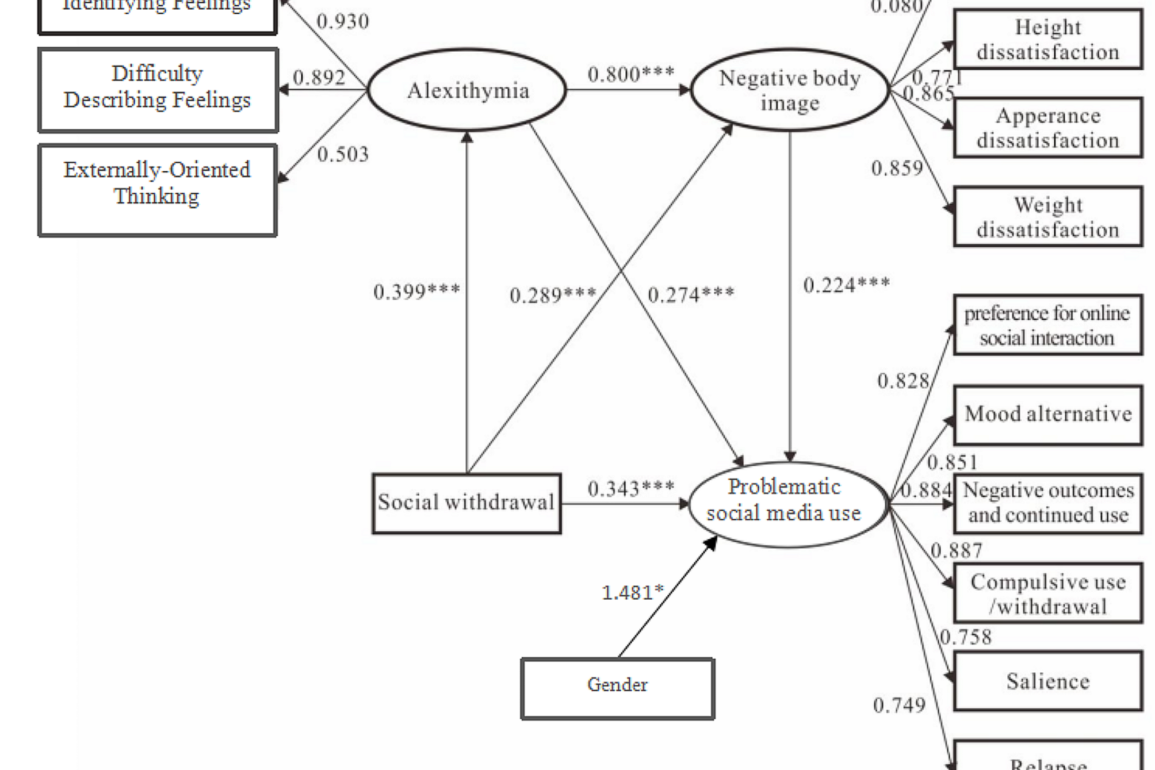
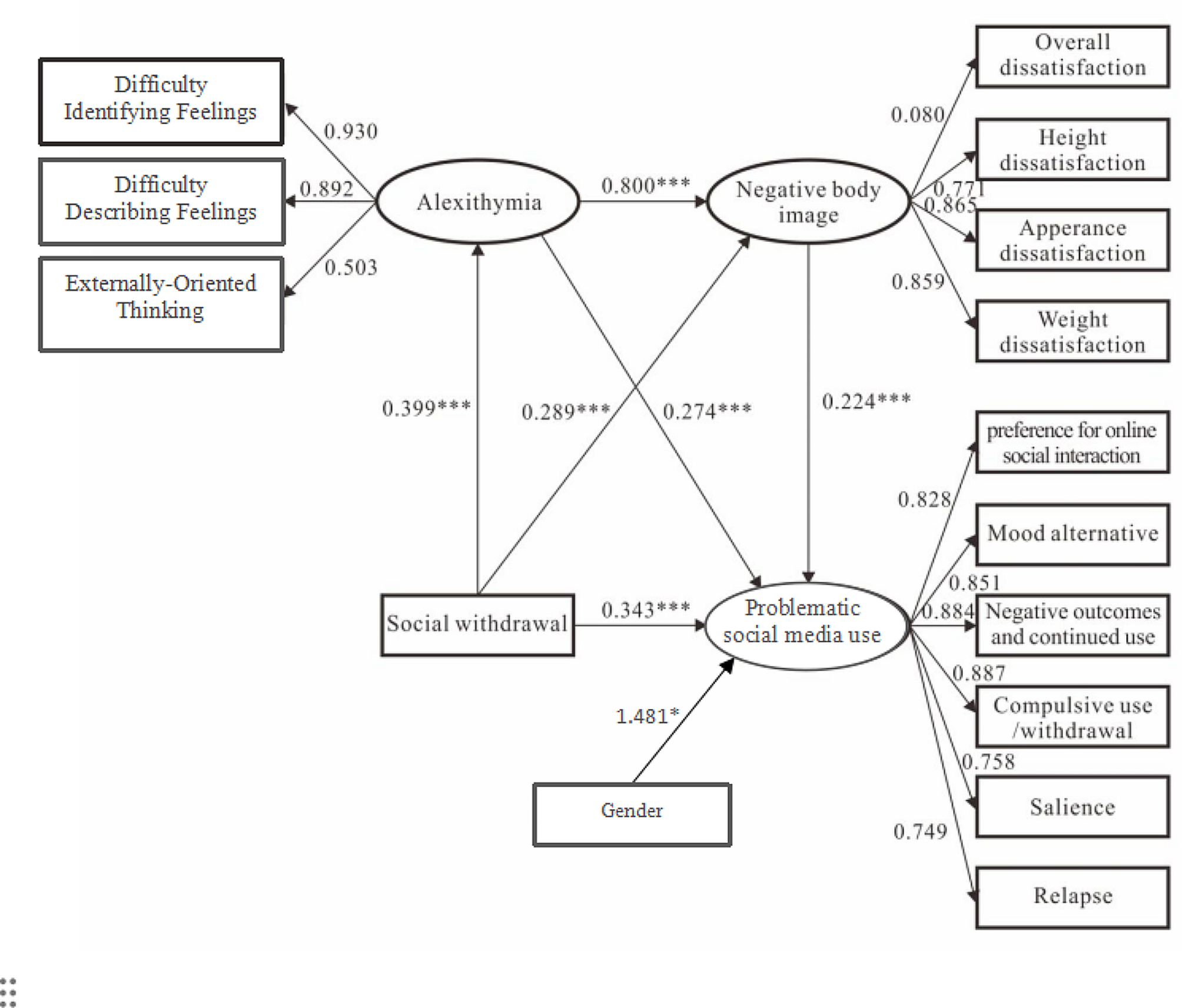
Based on the literature review and theoretical framework, this study posits three hypotheses to investigate the interplay between social withdrawal, alexithymia, negative body image, and problematic social media use. Hypothesis 1: Alexithymia acts as a mediating variable in the relationship between social withdrawal and problematic social media use, with social withdrawal influencing alexithymia, which in turn increases the likelihood of problematic social media use. Hypothesis 2: Negative body image mediates the relationship between social withdrawal and problematic social media use. Hypothesis 3: Social withdrawal indirectly shapes problematic social media use through the chained mediation effects of alexithymia and negative body image.
This post was originally published on this site be sure to check out more of their content