



Design
This pilot study was a single-blind, 2-arm, parallel design, non-randomized trial with convenient sampling. The study was approved by the Ethics Committee of the Institute of Psychology, the Chinese Academy of Sciences (approval number: H21081), and registered in the Chinese Clinical Trial Registry (ChiCTR2100053779, 29/11/2021). We aimed to examine the feasibility of the social network enhancement intervention for two groups of older adults from a Chinese community. Moreover, we examined the effects of the intervention on social network indices, depression, and global mental health levels in the intervention group.
Participants
This study was sampled from a community in Mentougou District, Beijing. By calculating sample size based on pilot studies and referring to previous studies, a sample size of 20–30 has been chosen for the current study [19, 20]. The whole network research usually adopts the principle of non-random cluster sampling [21]. We informed the community committee staff of the inclusion and exclusion criteria. They selected two independent residential buildings with a similar number of elderly residents to form the intervention and control groups for this study, and mobilized all eligible elderly individuals as participants. All participants signed a written informed consent form prior to the activities. Inclusion criteria: (1) Age 60 and above; (2) Residents who have resided in this community for more than one year; (3) Have basic communication skills; (4) Agree to participate in the entire event and undergo testing fully. Exclusion criteria: (1) Having confirmed mental illness, cognitive impairment, or severe emotional problems; (2) Diagnosed visual, hearing, or language impairment; (3) Physical diseases with restricted mobility (including arthritis that restricts daily activities, stroke, and neurological disorders). Finally, 31 eligible older adults were recruited to participate in the pilot study, including 15 in the intervention group and 16 in the control group (see Fig. 1).
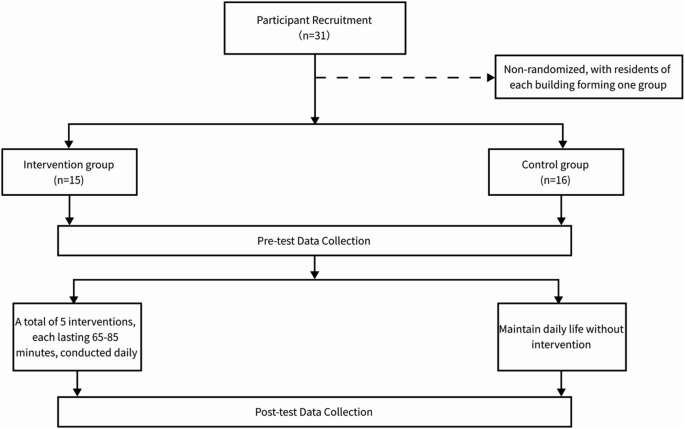
Flow diagram of the study
Social network enhancement intervention
The intervention consisted of in-person group training sessions led by coaches who had received standardized training, along with after-class exercises completed as homework. Participants in the intervention group received 12-session social network enhancement program, with one session held weekly., which included two sessions for an introduction to the course, two sessions for social emotion recognition, six sessions for social cognition, one session for review, and one session for course summary (see Table 1). Each face-to-face session lasted 60 to 90 min. The control group maintained their usual daily activities without receiving any intervention.
This study’s intervention approach utilized the concept of Social Cognitive Intervention Training (SCIT), which delineated social emotion recognition and social cognition as two primary components [22]. Given the potential decline ToM among older adults [23, 24], we reduced the emphasis on emotional perception training while amplifying social cognition interventions. We recorded video demonstrations and case analyses relevant to older adults’ experiences, such as “Mrs. Wang’s Dislike for Medical Check-ups” and “My Granddaughter’s College Entrance Exam.” Throughout the sessions, we integrated theoretical explanations of social networks and mental health to comprehensively enhance older adults’ ToM and motivation for social interaction, thereby strengthening their social networks.
Furthermore, we designated the older adult with the highest in-degree centrality (popularity) as the group leader, responsible for reminding participants to attend classes on time, assisting with homework, and encouraging participation during group interactions to enhance the intervention’s effectiveness.
The intervention comprised 12 face-to-face group sessions supplemented by homework assigned at the end of each session for older adults to practice. A psychology graduate student with qualifications in psychological counseling led the teaching, supported by another psychology graduate student serving as a teaching assistant. Prior to the intervention, the graduate students underwent training based on a standardized manual we developed and conducted at least two trial sessions to ensure the duration and completeness of the course. The course began with two introductory sessions focused on group formation, setting course objectives, and fostering familiarity among members. This was followed by ToM enhancement training, which included two sessions on social emotion recognition and six sessions on social cognition. In the 11th and 12th weeks, we conducted comprehensive exercises to review the learned material and engage in advanced activities, such as role-playing scenarios and sharing personal insights from the entire course.
Each session followed a structured design that included four components: homework sharing, theoretical introduction, discussions and exercises, and homework assignments. To ensure the completeness and uniformity of each session, we developed the ‘Social Network Enhancement Intervention Manual,’ which included the overall structure and verbatim scripts for each session’s content. At the beginning of each session’s outline, there was an evaluation form to be monitored and completed by the teaching assistant. This form recorded the duration and completion status of each section. If a section was not completed as planned, the instructor was required to provide an explanation in the ‘Incomplete’ section, facilitating post-session evaluations of course quality. For specific course details, refer to Table 1.
Homework activities included meeting new friends in the community, discussing specific social topics with family members, and engaging in conversations related to course content. Participants shared their homework during the next class, followed by group discussions.
Feasibility study
We selected the most critical five sessions from the entire course (including one session on group building, one on social-emotional recognition, and two on social-cognitive training, with one review session) as the pilot study course. The structure of each session remained unchanged. The course duration and the participants’ composition were identical to the formal intervention. During the pilot phase, a control group was set up with older adults residing in one building that did not receive any intervention and maintained their regular daily routines.
Feasibility monitoring and quality assurance
Throughout the course, the instructor and assistant continuously monitored any potential risks to the participants’ physical and mental health. After the courses, the feasibility of the intervention course was assessed using two indicators: compliance and satisfaction, which were measured through questionnaire surveys, attendance records, and completion rates of homework assignments. Participants’ subjective satisfaction with the pre-and post-test questionnaires was evaluated, and their acceptance of the course content was examined through interviews.
The quality of the study was continuously monitored throughout all stages of data collection and the entire intervention implementation. The study followed the standardized intervention manual procedures meticulously, including the duration of each session, coaching instructions, multimedia aids (videos), game materials, and worksheets in the classroom. Coaches and assistants summarized the progress of each week’s session to monitor the quality and progress of the intervention.
Safety considerations
This study carried low risk since it involved enhancing the social networks of older adults through group activities, lecture sessions, and post-class exercises, constituting a non-pharmacological intervention. Although serious adverse events were not expected, we continuously monitored any potential incidents during each group session. The group coaches were trained professionals, and a standardized intervention manual was provided with methods to address any potential adverse events, thereby ensuring the safety of the intervention to a large extent.
Measurement
Demographics and background factors: A self-designed questionnaire was used to collect demographic information from the participants, including age, gender, years of education, socio-economic status (annual income of themselves or their spouses, and the scoring method was as follows: 1 for annual income less than 5,000 Yuan, 2 for 5,000–10,000 Yuan, 3 for 10,000–30,000 Yuan, 4 for 30,000–50,000 Yuan, 5 for 50,000-100,000 Yuan, 6 for more than 100,000 Yuan.) (Note: 1 Yuan approximately equal to 0.14 US dollars), and number of children. The background factors assessed were subjective health state and social participation. The physical health status (“How would you rate your health condition?”) of the tested 6-point Likert scale was 1 as “very good” and 6 as “very bad.” Social participation comprised five items: (1) Communicating and chatting with people, (2) Playing card games, (3) Engaging in group fitness or dancing, (4) Participating in collective activities, (5) I was joining volunteer groups. Scores for the frequency of social participation ranged from 1 (rarely or never) to 5 (almost every day). The total score ranged from 5 to 25, with higher scores indicating a higher frequency of social participation.
Primary outcome
Feasibility. The feasibility was measured by compliance and satisfaction with the intervention. According to previous studies [25,26,27,28], compliance was measured through the following criteria: (a) attendance rate. At least 80% of the subjects’ attendance rate reached 80% to meet the standard; (b) homework completion. At least 80% of the subjects completed 80% to meet the standard. Satisfaction was assessed through a 5-point Likert scale questionnaire, which includes overall satisfaction, helpfulness in daily life, course enjoyment, knowledge acquisition, perceived safety, possibility of recommending to others, and willingness to participate in formal interventions [29,30,31,32]. Additionally, an open-ended interview was conducted to inquire about the participants’ gains from the intervention and their suggestions for the course.
Secondary outcomes
Theory of Mind. The emotional component of the ToM was measured using the Mental State Reading Task in the Eye Task; the Faux Pas task measured the cognitive component of the ToM.
The Mental State Reading Task required the participants to choose one of the four alternative words that best reflected the character’s psychological activities according to the eye area pictures (34 in total, 17 for men and 17 for women). These alternative words were selected based on the original research’s vocabulary list and were annotated regarding the “Modern Chinese Dictionary” (7th edition). The 34 eye area pictures were the localized and assessed Asian face pictures [33], with a score range of 0–34 points. The higher the score, the better the emotional recognition level.
The faux pas task was used to measure the participants’ social cognitive ability in ToM [34]. For this task, Baron-Cohen’s open-source repository was adopted. To ensure compatibility with the habits of older adults in China, original foreign names were replaced with more common names among Chinese older adults without changing the basic meaning of the story. The ten stories (five faux pas and five control stories) were randomly shuffled and read to participants. If the participant did not understand the content of a story, the story was repeated until they understood. The stories in the pre-test and post-test were different and randomly selected. Faux pas stories were scored, and control stories were not scored. After each story, the participants were asked six questions, which individually assessed the participants’ abilities to perceive Faux Pas situations, understand the Faux Pas scenarios, comprehend the mental states of both the listener and speaker, grasp the intentionality of the behavior, and evaluate empathetic abilities. The score range for the Faux Pas Task is 0–30 points, with higher scores indicating better cognitive levels of ToM.
Social Network. The interview method was used to collect the participants’ ego network and whole network information, respectively. The following questions were posted for ego network interviews: (1) Contact (face-to-face or remote) at least once a month on average; (2) People/organizations that are emotionally/physically important to you. There was no upper limit for nominations, and the size of an ego network was the number of nominations. Diversity refers to the statistics of different types of social relationships, including core and extended family members, friends, and community organizations [35].
For the whole network interview, we listed a list of all the older adults aged 60 in the village who participated in the interview. Participants were asked to select whether they considered each person on the list a “friend.” The term “friend” was operationally defined as meeting the following criteria: (1) Having contact with the person at least once a week, and (2) Having emotional recognition and liking for each other. Subsequently, participants were asked to make their selections based on this definition. The calculation of whole network metrics included in-degree centrality, which represents the number of older adults chosen as friends by others, reflecting the popularity of the older adults, and reciprocity, which indicates the number of mutual friendships. Since this study involved two communities, all whole network metrics were standardized. To explore the effects of the whole network structure, we also calculated the density of the whole network for both groups before and after the intervention. For specific ego and whole network metric details, please refer to Table 2.
Additional outcome
Mental Health. We used the Mental Health Inventory for the Elderly (MHIE) to assess participants’ global mental health levels. This MHIE scale consists of 65 items, measuring older adults’ global mental health status across five dimensions: cognitive efficacy, emotional experience, self-awareness, interpersonal interactions, and adaptability. The scale uses a 4-point Likert scoring system (1 = totally disagree; 4 = totally agree), with higher scores indicating better global mental health [36]. To assess the participants’ emotional state, we employed the Center for Epidemiologic Studies Depression Scale (CES-D). The scale uses a 4-point Likert scale (1 = rarely or not at all/less than one day, 4 = most of the time/5–7 days), with higher scores indicating more severe depression [37].
Data collection
Data collection was conducted simultaneously in two residential buildings. Individual interviews were conducted to assess demographic information, course satisfaction, and social network indicators. The pre-test was completed within one week before the intervention began, and the post-test was completed within one week after the intervention ended. The study was designed as single-blind. Teaching assistants recorded attendance and completion of homework, while trained researchers collected participants’ ToM scores through standardized tasks. Participants’ global mental health levels were assessed through self-evaluation.
Considering issues related to the visual acuity of older people and their acceptance of electronic devices, data in this study were collected through paper-based questionnaires. Trained graduate students conducted the data collection process, and data input was completed using Epidata software.
Analysis
Descriptive statistics for baseline data and the analysis of differences in mental health indicators before and after the intervention for the two groups were conducted using SPSS 22.0. The general characteristics of the participants were analyzed using independent sample t-tests and chi-square statistical methods, repeated measures analysis of variance was used to analyze the participants’ ToM scores, and the chi-square analysis was used to compare the whole network density between two groups before and after the intervention.
All outcome variables were analyzed at the 0.05 α level. The whole social network centrality and reciprocity were analyzed using UCINET software. Feasibility records and interview findings related to the intervention were presented in tabular form.
This post was originally published on this site be sure to check out more of their content