


The oral health is a public concern in the Republic of Serbia, where high rates of dental caries, periodontal disease, and edentulism are often exacerbated by limited access to dental care. Approximately 600 private dental practices employ around 650 dentists across Vojvodina [23]. Yet, the majority are concentrated in urban centers, leaving smaller towns and rural areas with limited or no access to dental services [26]. The study aimed to explore the role of social media in influencing residents’ choices when selecting a dentist and dental clinic. It also investigated which types of posts respondents found most helpful and gathered their views on both the advantages and limitations of social media in relation to content shared by dental professionals.
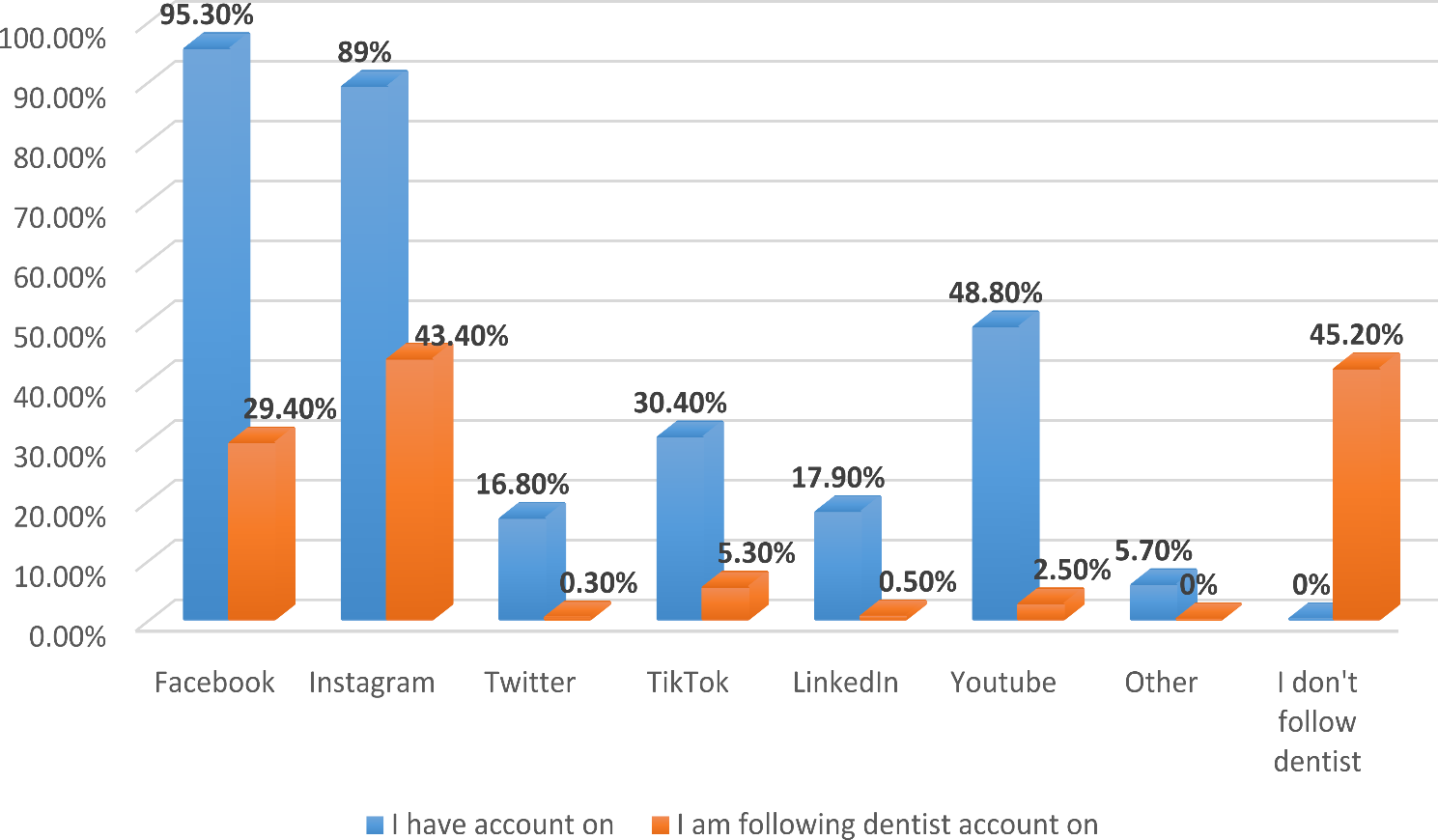
The majority of participants in our study had Facebook (95.3%) and Instagram (89.3%) accounts, mirroring trends noted in the Digital 2024: Global Overview Report, which ranks Facebook, Instagram, and YouTube as the top platforms in Serbia [5]. These patterns align with findings from Saudi Arabia and Kuwait [19, 27]. Over half of our participants (58.5%) spent 1–3 h daily on social media, with younger individuals, particularly those aged 18–25, leading in usage (Table 2). This finding is consistent with global averages and research showing higher activity levels among younger generations [5, 28,29,30].
More than 50% of our participants followed a dentist or dental clinic account, a notably higher percentage than that reported in similar studies [31,32,33]. Female participants were significantly more likely to follow these accounts than male participants (Table 2). This trend may partly reflect the gender imbalance in our sample, as women often place higher value on social media interactions and are more inclined to follow health-related content, including dentistry [34]. Additionally, social media platforms, especially Instagram, are often focused on aesthetics and visual content. Since dental services are frequently associated with aesthetic aspects, women may be more interested in following dentists’ content on these platforms [35]. Respondents aged 26–35 years were notably more likely to engage with dentists on social media (61%). This age group, familiar with digital technologies, frequently turns to online platforms for information due to their internet proficiency, critical thinking skills, and growing trust in social media as a source of reliable information [36].
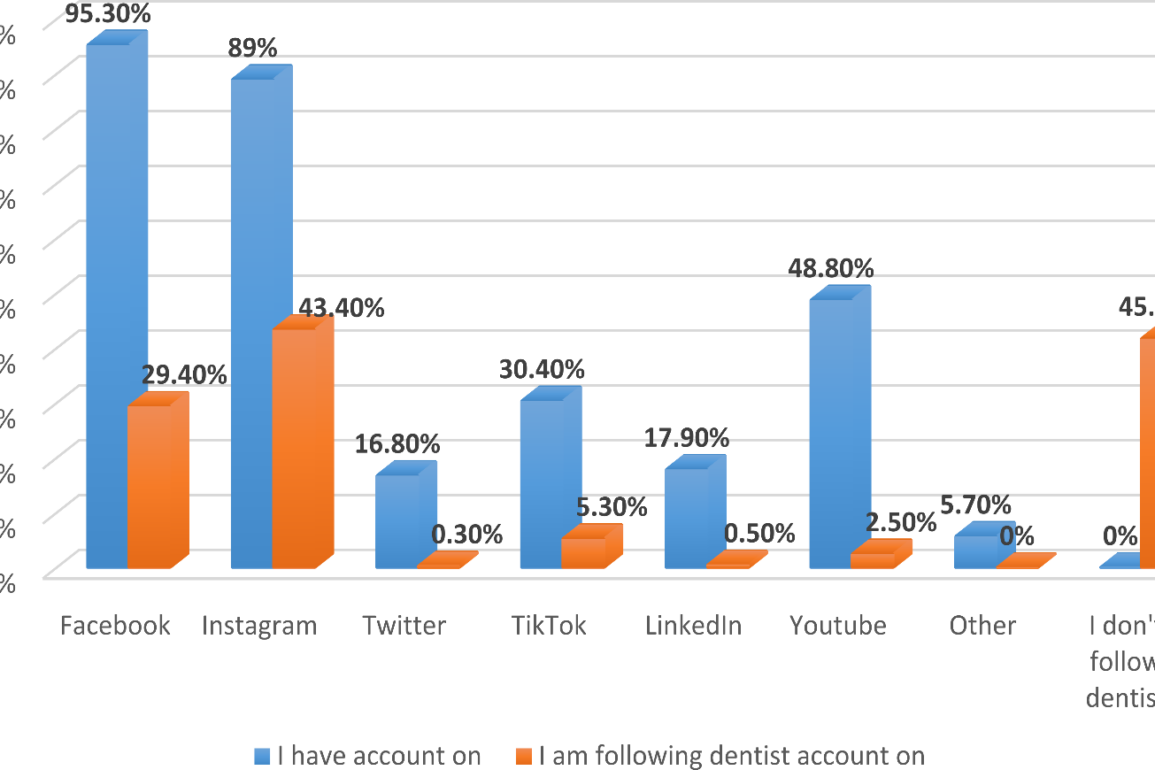
Most participants who followed a dentist or dental clinic on social media preferred Instagram (43.4%), followed by Facebook (29.4%) (Fig. 1). In contrast to findings from India, where YouTube was the primary platform for dental information [33, 37]. We believe that Instagram’s user-friendly interface and the ability to browse public accounts likely contributed to its popularity among our participants, allowing easy access to images and videos posted by dentists [38].
Although 67.2% of respondents in our study highlighted quick and easy access to information as a benefit of social media (Figs. 4), 60.3% stated that they would not select dentist/dental clinic based on its social media presence (Table 2). The majority of participants (62.4%) expressed concern about the promotion of potentially harmful trends, and more than half (55.4%) questioned the credibility and accuracy of information. In study conducted in Kuwait [19], some participants were influenced by social media posts to try new products, while some claimed that such posts led them to make incorrect oral health decisions. However, in contrast to our study, more than half respondents from the same research [19], would select a dentist based on their social media presence. This disparity can be explained by the higher percentage of Kuwaiti participants (76.3%) following a dentist on social media compared to our study (54.8%), reflecting the complexity and dynamics of social media.
As shown in Fig. 3, those who would select a dentist based on their social media presence primarily considered the number and type of comments on dentists’ profiles (46.41%), followed by patient experiences shared by dentists (37.5%). However, it is important to note that social media reviews can be subjective and may not always accurately reflect quality of the services offered by dentist [39]. Individuals have different standards and expectations, which can influence their ratings. Furthermore, some dentists or clinics may pay for fake positive reviews, or even negative reviews to harm competitors [40], which can significantly distort the true picture of service quality. Moreover, before-and-after photos of dental procedures that promise quick and miraculous results can create unrealistic expectations among patients, leading them to expect similar outcomes without fully understanding the complexities involved.
It seems that the majority of respondents in our study are aware of limitations of social media as a source of information. Although most participants reported that posts from dentists expanded their oral health knowledge, only a small percentage considered it their primary source of information (22%), even among youngest categories (26%) (Table 3). This suggests that individuals across all age groups may still rely more on traditional sources of information, such as advice from healthcare professionals, family members, or friends when making decisions about dental procedures [41]. Older individuals, in particular, may place more trust in traditional sources of information or view social media as less reliable for healthcare information [42]. The level of trust in social media content can also vary depending on the culture and social norms. For instance, in India [31], a majority of respondents (56.6%) trusted posts from dentists on social media, whereas research by A Vinita Mary et al. [33] showed that many participants were neutral regarding the information they receive from dentists on social media. While social media offers significant potential for health promotion, it should not be considered a replacement for traditional, trusted sources of health information [2]. Health-related content on social media is often simplified to fit the platform’s format, which can lead to an oversimplification of complex health issues. Unlike official medical recommendations, social media posts are not subjected to rigorous review by medical experts [43]. As a result, dentists may unintentionally or, in some cases, intentionally share information that is not scientifically supported or may be outdated. This can lead patients to make decisions based on incomplete or misleading information obtained from social media, potentially resulting in the selection of inappropriate treatments or neglect of necessary dental care.
According to various studies, approximately 10–20% of the population experiences significant dental anxiety, which can range from mild apprehension to severe phobia, affecting individuals’ willingness to seek dental care [44]. In our study, 42.5% of respondents reported fear of visiting dentists, which is higher than the global average. This may be attributed to the higher proportion of female participants, as studies indicate that women are more likely to experience dental anxiety [44]. Among those who reported fear, 56.5% felt that dentists’ social media posts did not help alleviate it (Table 3). Buchanan et al. [45], suggest that online support groups can be valuable role in providing understanding for individuals facing dental phobia. While social media posts can offer useful information and support, deeply rooted dental fears may require additional support beyond online content, such as professional reassurance or therapy.
Furthermore, the results of multivariable binary logistic regression analysis revealed that age and educational level were significant predictors of selecting a dentist/dental clinic based on their social media presence (Table 4). The probability of participants aged 18 to 25 years selecting a dentist/dental clinic based on their social media account was 1.848 times greater compared to those older than 46 years (95% CI: 1.144–2.983; p < 0.001). These findings are consistent with those reported by other studies [46, 47]. Additionally, participants with a high school education were 1.54 times less likely to select a dentist/dental clinic based on their social media presence compared to those with the highest level of education (95% CI: 0.472–0.891; p < 0.05). This finding concurs with the results obtained in other studies suggesting that better educated individuals are more likely to utilize online resources [48, 49].
While the study provides insightful data on the role of social media in selecting dentist, there are limitations regarding sample population. The generalizability of the findings is constrained due to regional differences, as Vojvodina generally has a higher level of educational attainment and a more diverse population compared to other parts of Serbia. Additionally, the survey participants were not evenly distributed across gender and age groups, with a higher proportion of female and younger respondents. In both Vojvodina and Serbia, females outnumber males. Consequently, gender differences in survey participation are consistently observed, with women being more likely to respond than men, especially in mail or web-based cross-sectional surveys [50]. However, the proportion of female respondents in our study (nearly 80%) is higher than in similar studies, where females typically account for around 60% of the sample [32]. This gender imbalance is difficult to explain, given a significant lack of understanding about the individual reasons for (non)participation in academic research [50]. Available evidence indicates that males who adhere to traditional masculinity norms often exhibit less interest in engaging in constructive communication with others and authorities [51]. These gender differences contribute to lower survey participation rates among men in patriarchal societies. As Serbian society is still based on a traditional male-female social organization model, this might have led to a lower response rate among men in our research. Moreover, reliance on self-reported data raises the possibility of bias because those who were more interested in the subject may have been more likely to participate [52]. Additionally, a limitation of this study is that the questionnaire has not been tested for reliability, which may impact the consistency.
Considering the growing reliance on social media as a source of health-related information, it is crucial to further explore how dental professionals can leverage these platforms effectively. Building on the findings of this study, future research should focus on investigating how dental professionals can use social media to build trust, challenge misconceptions, and provide evidence-based information to the public. Future studies could analyze the effectiveness and engagement of different social media platforms individually to understand which platforms are more influential in healthcare choices. Expanding the study to include diverse regions outside of Vojvodina or a cross-national sample could reveal regional or cultural differences. Additionally, research could explore whether social media impacts patients’ choice of specific dental interventions across various branches of dentistry, which may highlight unique preferences or informational needs related to each specialty.
This post was originally published on this site be sure to check out more of their content