

A total of 58 participants completed the questionnaire, resulting in a response rate of 77.34%. The participants had a mean age of 43 ± 18 years and an average work experience of 16 ± 41 years. Of the participants, 41 (70.69%) were male, and 17 (29.31%) were female. The participants in this study identified 18 organizations as the key actors in brucellosis prevention programs in Lorestan province. These organizations include the Lorestan University of Medical Sciences (LUMS), Veterinary Organization of Lorestan Province (VOLS), Ministry of Agriculture, Jahad (AJ), Environmental Protection Organization (EPO), Lorestan Broadcasting Organization (LBO), Red Crescent Society (RCS), Non-Governmental Organizations (NGOs), Medical Society Basij (MSB), Governorship and District Administrations (GDA), Barakat Foundation (BF), Imam Khomeini Relief Committee (IKRC), Provincial Management and Planning Organization (PMPO), Universities and Research Centers (URC), Ministry of Cooperatives, Labor, and Social Welfare (CLSW), Welfare Organization (WO), Ministry of Education (OoE), Police (Po), and Guilds and Unions related to Animal Husbandry, Agriculture, and Food (GUAF). Local farmer associations and cooperatives, which are a sub-group of the Agricultural Jihad (AJ), also participated in the brucellosis prevention program. These groups provide services such as purchasing dairy or meat from livestock farmers, coordinating livestock vaccination campaigns, and collaborating with government agencies. Table 1 presents the names of these actors along with their activities related to the brucellosis program.
-
1.
Power
VOLS is the most powerful stakeholder, scoring 100, signifying its central role in livestock health and vaccination programs. LUMS and AJ follow with scores of 95 and 90, respectively, highlighting their critical roles in medical and agricultural aspects of brucellosis prevention. GUAF scored 85, emphasizing their importance in ensuring hygienic practices. Other organizations such as RCS, NGOs, and EPO have moderate power (scores between 50 and 60), reflecting their supplementary but significant contributions.
-
2.
Support
VOLS and LUMS again top the list with scores of 100 and 95, respectively, showcasing their strong commitment to prevention and control programs. AJ and EPO scored 90 and 85, respectively, indicating active participation in promoting hygiene and monitoring disease spread among wildlife. Stakeholders such as NGOs and BF scored lower [20], reflecting limited direct involvement or resource allocation for brucellosis prevention efforts.
-
3.
Influence
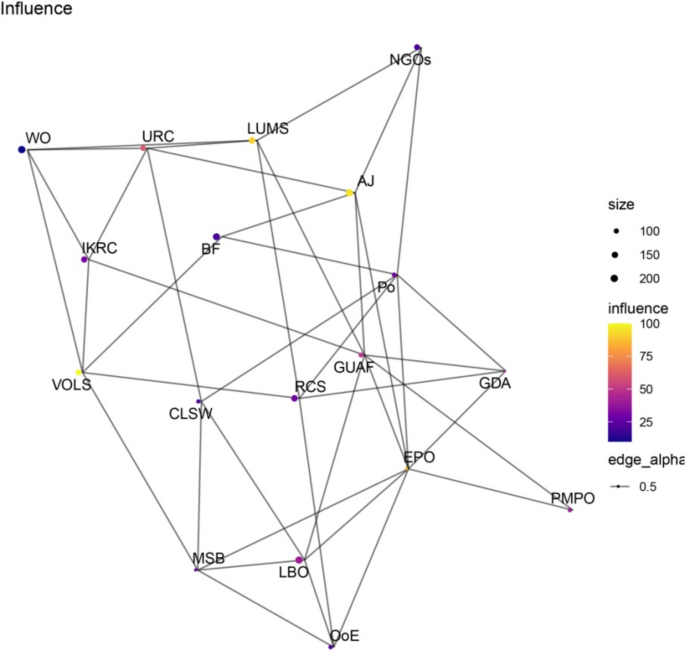
VOLS, AJ, and LUMS lead with scores of 100, 95, and 90, indicating their pivotal roles in shaping and implementing brucellosis-related policies. EPO and URC scored 85 and 60, highlighting their influence through ecological monitoring and research contributions. Organizations like NGOs, BF, and WO scored lower (20–10), suggesting they play a supportive rather than decisive role in influencing brucellosis policies.
-
4.
Interest
LUMS scored the highest (100), underlining its dedicated involvement in prevention, diagnosis, treatment, and public education. VOLS, AJ, and EPO followed closely with scores of 95, 90, and 85, respectively, showing their significant interest in controlling the disease. NGOs, BF, and WO scored lower (30–20), reflecting less focused involvement or competing priorities.
The scores for each stakeholder across the four items are provided in supplementary 1.
SNA analysis
Figures 1, 2, 3, 4 present network maps illustrating the influence, interest, level of support, and power of stakeholders involved in brucellosis prevention in Lorestan province. Table 2 presents the key network metrics for various stakeholders.

Network map illustrating the influence of stakeholders in brucellosis prevention

Network map depicting the interest of stakeholders in brucellosis prevention

Network map showing the level of support from stakeholders in brucellosis prevention

Network map representing the power of stakeholders in brucellosis prevention
The social network analysis of stakeholders involved in the Brucellosis prevention program in Lorestan province highlights the roles and influence of key actors through various centrality metrics. Among the stakeholders, EPO and GUAF emerged as the most prominent, demonstrating their critical positions within the network. EPO exhibited the highest degree centrality (0.4706), indicating its extensive connections and pivotal role in fostering collaboration among stakeholders. Similarly, GUAF ranked second in degree centrality (0.4118), reflecting its significant connectivity. Both actors also recorded the highest closeness centrality scores (0.6296), signifying their ability to efficiently access and disseminate information throughout the network. In terms of betweenness centrality, GUAF (0.1469) and EPO (0.1456) held the highest values, underscoring their roles as key intermediaries facilitating communication and resource flow between other actors.
Eigenvector centrality further emphasized EPO as the most influential stakeholder (1.0000), reflecting its connections to other highly influential nodes, with GUAF (0.8433) closely following. Hub and authority scores confirmed EPO as the most critical hub, highlighting its capacity to connect with authoritative stakeholders. Similarly, the PageRank metric identified EPO (0.0898) and GUAF (0.0802) as the most significant actors, reinforcing their overall importance within the network. These findings indicate that EPO and GUAF play pivotal roles in the Brucellosis prevention program, serving as key facilitators of collaboration, information exchange, and decision-making. Engaging and supporting these stakeholders is essential for optimizing the program’s effectiveness and achieving its objectives. This analysis demonstrates the utility of social network analysis in identifying influential actors and enhancing stakeholder engagement in public health initiatives.
Table 3 provides an overview of the key structural metrics for the social network of stakeholders involved in brucellosis prevention programs in Lorestan province. These metrics summarize the network’s overall properties and reveal insights into the connectivity, cohesion, and efficiency of stakeholder interactions. The network consists of 18 unique stakeholders (nodes), each representing a key actor in the brucellosis prevention program. These stakeholders are connected through 42 edges, signifying relationships or interactions relevant to the program’s objectives. The density of the network is 0.2745, indicating that approximately 27.45% of all possible connections between the stakeholders are present. This suggests a moderately connected network where not all stakeholders are directly linked to one another. The average clustering coefficient is 0.2839, reflecting the tendency of stakeholders to form tightly knit groups or clusters. This value suggests a moderate level of clustering within the network, indicating localized collaboration among subsets of stakeholders. On average, each stakeholder is connected to approximately 4.67 others, as shown by the average degree, highlighting the general level of stakeholder interaction within the network. Additionally, the network contains 14 triangles, representing sets of three stakeholders that are all mutually connected. These triangles highlight areas of strong collaboration or cohesion within the network. The diameter of the network is 3, meaning the longest distance between any two stakeholders is three steps or connections. This, combined with an average path length of 1.8954, shows that stakeholders are generally well-connected and can typically reach one another in fewer than two steps. Overall, these metrics illustrate the structure and dynamics of the stakeholder network, providing valuable insights into its potential effectiveness in facilitating collaboration, information flow, and coordinated efforts in brucellosis prevention.
Figure 5 highlights the most influential actors in the brucellosis prevention program in Lorestan Province, based on their composite scores. Composite scores were calculated by averaging the scores for influence, interest, power, and support, with equal weighting applied to each dimension.

Most important actors based on composite score
Actors such as VOLS (1.88), LUMS (1.75), and AJ (1.39) exhibit the most prominent positive red bars, highlighting their roles as key contributors with strong positive influence in Brucellosis prevention efforts. Conversely, actors such as WO (-1.28), CLSW (-0.9), and MSS (-1.0) show negative values, suggesting they may negatively impact the outcome or hinder progress toward the goal. The apparent discrepancy between the SNA metrics (highlighting EPO and GUAF) and the composite scores (highlighting VOLS, LUMS, and AJ) can be explained by the fact that SNA metrics focus on network structure and connectivity, while composite scores reflect the overall influence, interest, power, and support of stakeholders. Both perspectives are complementary and provide a comprehensive understanding of stakeholder roles.
Statistical validation and sensitivity analysis
We compared the observed network with 1000 randomized networks generated using the Erdős–Rényi model. The observed network density (0.2745) and clustering coefficient (0.2839) were significantly higher than those of the randomized networks (p < 0.001), indicating that the observed patterns of collaboration among stakeholders are non-random and reflect meaningful interactions. To evaluate the stability of the network, we systematically removed key stakeholders (e.g., VOLS, LUMS, EPO) and recalculated the network metrics. The results demonstrated that the removal of these stakeholders led to a measurable decrease in network density and centrality metrics, underscoring their critical roles in maintaining the network’s structure. However, the overall network properties remained stable, indicating that the findings are robust and not overly dependent on any single actor. These analyses confirm that the stakeholder network is both statistically significant and resilient to the removal of key players, reinforcing the reliability of our findings and their implications for brucellosis prevention efforts.
This post was originally published on this site be sure to check out more of their content