



Study design
The study conducted is a cross-sectional, correlational type of research. The study was conducted to assess the relationship or association of SMA with psychosocial problems like depression, anxiety, and stress using a suitable questionnaire, on employees/working professionals (97 teaching staffs and 108 non-teaching staffs) [25].
Study site
The study was conducted at JSS Academy of Higher Education and Research (JSS AHER) in Mysuru, Karnataka, India.
Participants
The study included N = 200 participants of both genders. Among them, there were 200 employees/working professionals (97 teaching staffs and 108 non-teaching staffs) of > 24 years. The sample size of 200 was calculated using the Slovin or Yamane formula, where the standard of deviation, P = 0.5; margin of error, e = 0.04; confidence interval is 95%; population size, N = 2500 was considered [26]. The enrollment was not based on the history of depression, stress, and anxiety. However, the depression, stress, and anxiety were evaluated based on SMA. Inclusion criteria included employees/working professionals of either gender (age > 24), and participants willing to give their consent and participate in the study. Exclusion criteria included employees suffering from chronic diseases like heart disease, asthma, and cancer. This study was carried out in accordance with the Declaration of Helsinki. All study procedures were approved by the Institutional Ethics Committee (IEC Registration ECR/387/Inst/KA/2023/RR-19) at JSS Medical College, Mysuru, and obtained informed consent from all employees which was included in the Google Forms depicted in supplementary materials.
Procedures
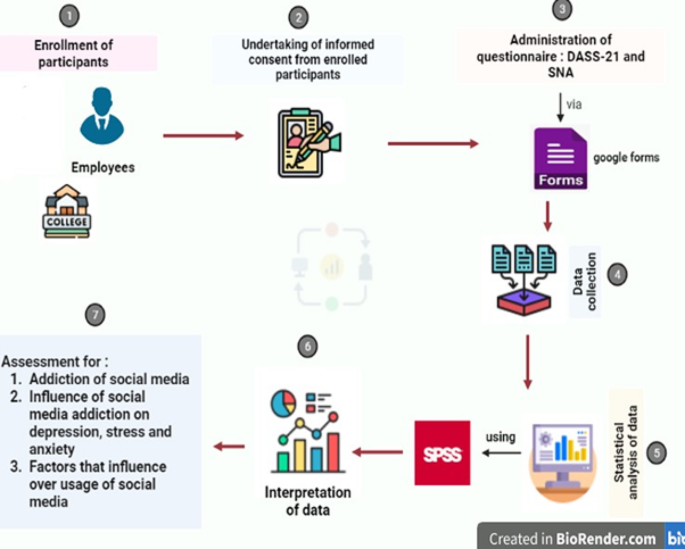
An online survey had been conducted for the assessment of the impact of SMA on psychosocial behaviours such as depression, stress, and anxiety. A link to a structural questionnaire created with ‘Google Forms’, was sent to employees via WhatsApp and email. The response collection tool was built by a combination of two scales: the DASS-21 and social networking addiction scale (SNAS). Demographical information was also included in the questionnaire. Before participation, consent was obtained from employees, and all information provided was assured of confidentiality. The process of the study is depicted in Fig. 2. The questionnaire took an average of 5–10 min to complete. The form was completed by 205 employees (96 males and 109 females). When the forms were examined after the study, 5 forms were not evaluated due to incomplete data. Therefore, the data collection process was completed with 200 forms. The validity and reliability of questionnaire using the above-mentioned methods have been validated in the previous studies [17, 27, 28]. Therefore, the validity studies were not performed in the present study.

A pathway model analysis in the investigative study
Data collection tools
Sociodemographic characteristics
The survey sought questions about age, gender, and courses of employees (teaching and non-teaching), area of residence (Urban, suburban and rural), family type (joint and nuclear), marital status (married and unmarried), family income (lower, lower middle, upper class, upper lower, upper middle), social history (alcohol, tobacco), and mental health conditions and general health conditions, to create a profile of the participants’ sociodemographic characteristics.
DASS-21
The DASS-21, which has been used to assess mental health, was used to assess respondents’ mental health status. Three self-report measures are included in the DASS-21, which is intended to evaluate anxiety, stress, and depression. The seven elements on each of the three DASS-21 scales are broken down into subscales containing relevant data. According to Lovibond and Lovibond depression severity ratings range from 0 to 9, with 0 representing normal, 10–13 representing mild, 14–20 representing moderate, 21–27 representing severe, and 28 representing extremely severe. Anxiety has severity levels ranging from 0 to 7, with 0 being normal, 8–9 being mild, 10–14 being moderate, 15–19 being severe, and 20 or more being extremely severe. Stress is classified as 0–14 normal, 15–18 mild, 19–25 Moderate, 26–33 severe, and 34 or more extremely severe [29, 30].
SNAS
A 21-item Likert scale with seven possible responses was presented by Shahnawaz and Rehman in order to gauge how much a person experiences social network addiction. The possible range of the score is 21–147. A score of more than 84 denotes addiction, which is diagnosed at three different levels: mild, moderate, and severe. Factorial analysis of the scale is necessary to identify and evaluate the cultural and environmental factors that may influence these levels. People’s level of SMA can be determined and evaluated using the SNAS [31].
Statistical analysis
The data was statistically analysed using the SPSS Statistics Base V 28 version of the Statistical Package for the Social Sciences software which is used to perform meta-analysis. Descriptive statistical methods (frequency, percentage, mean) were used to evaluate the study’s data which included the demographic details and SNAS and DASS-21 severity scoring; Chi-square analysis also called Pearson Chi-square analysis (a statistical test used to examine the differences between the categorical variables) which is a non-parametric test, was used to find the association of SMA with depression, stress, and anxiety. The results were assessed using a 95% confidence interval [32].
This post was originally published on this site be sure to check out more of their content