

A former Tencent product designer who calls herself CryptoZR turned code, ledgers and auctions into art, sold 1,000 NFTs in two hours, and just brought the whole hustle to a free show at the Hong Kong Arts Centre.
Some artists paint. Liu Jiaying writes the rules and lets the market finish the piece. According to NFT Culture‘s Natalee, Liu, who works as CryptoZR, opened “CONSENSUS,” a solo show of her crypto art, on Nov. 5 at the Pao Galleries of the Hong Kong Arts Centre. It ran through Nov. 15 with free admission. Curated by Gu Zhenqing, it pulled together nearly a decade of what the outlet called “protocol-based practice,” with two new installations, A Fleeting Dream and Artbyss, debuting in Hong Kong.
The title is the point. In blockchain terms, NFT Culture explained, consensus means confirmation without a single authority, and Gu used that idea as the lens for the work Liu has made with protocols, ledgers and code since 2017.
From product designer to “crypto art”
Liu didn’t start in a studio. According to Wen Wei Po‘s newsdesk, she was a Global SNS product designer at Tencent before enrolling in the experimental art department at the Central Academy of Fine Arts. In 2017 she made Out of Nothing, a work built on blockchain’s underlying technology, and in 2019 she translated “CryptoArt” into Chinese as 加密藝術. NFT Culture noted that the term still shapes how this kind of work is discussed in the region.
Her big early hit was her graduation project. Wen Wei Po reported that 1000EYE arranges images of the eyes of 1,000 people in an Ulam spiral, and that its 1,000 NFTs were sold as blind boxes, sold out within two hours and brought in $3.06 million. According to Orange News‘ arts desk, those eyes circle the anonymous eye of Satoshi Nakamoto, a symbol of the distributed network’s collective gaze.

The doubters became the artwork
The title piece, The Consensus, is a jab at Bitcoin’s doubters. Wen Wei Po reported that it collects 410 reports from 2010 to 2024 by outlets including CNBC, Bloomberg and Forbes that questioned Bitcoin. The work’s math: buy $100 of Bitcoin every time one of those stories ran, and by 2024 you’d hold 1,043 bitcoin worth more than $100 million. The articles are printed in the layout of The Times with QR codes, and the data is inscribed on Bitcoin Ordinals. Swiss collector Uli Sigg added it to his collection in 2025, and it was shown at BitcoinAsia in Hong Kong that August.
Another piece makes collectors part of the art. For Red and Blue, Liu took the two colors of the U.S. flag, generated 100 gradient color blocks and auctioned them publicly for a year, Wen Wei Po reported. The most extreme blocks drew the fiercest bidding, and that bidding is part of the work. Orange News noted that the piece is now in the collection of Korea’s Ulsan Art Museum, and that her work has shown at the Venice metaverse biennale and London’s Saatchi Gallery.
“The next one”
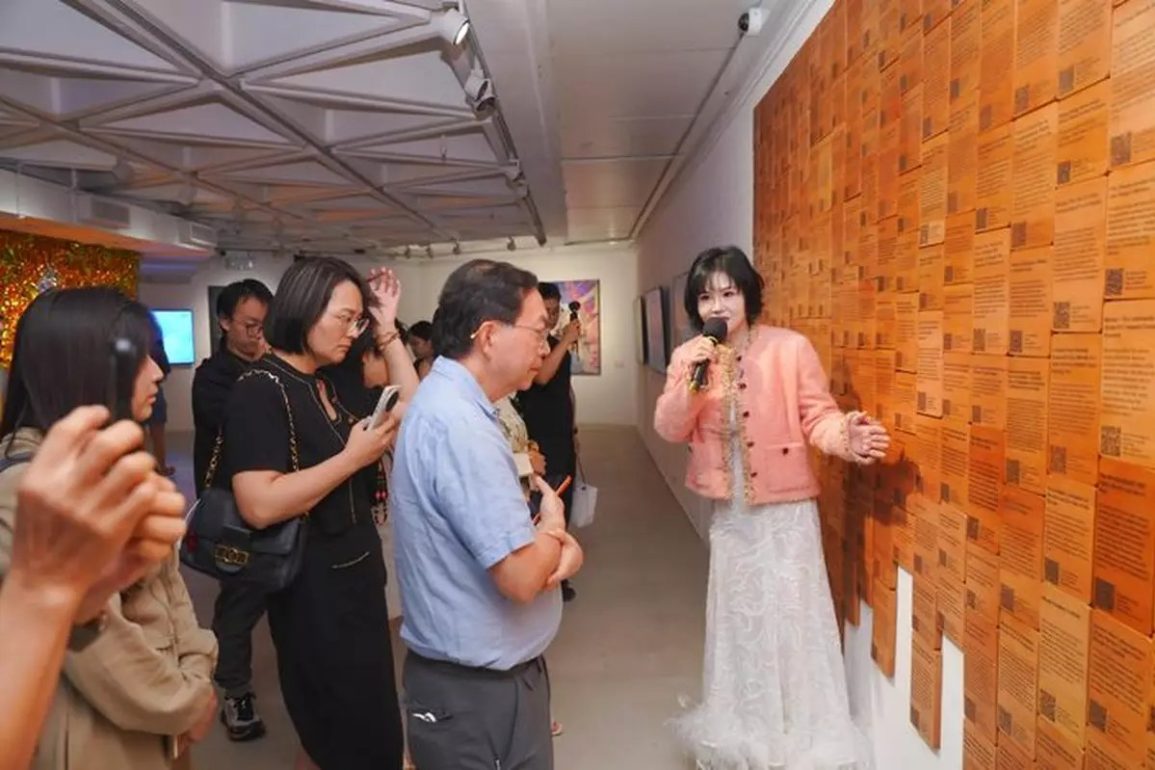
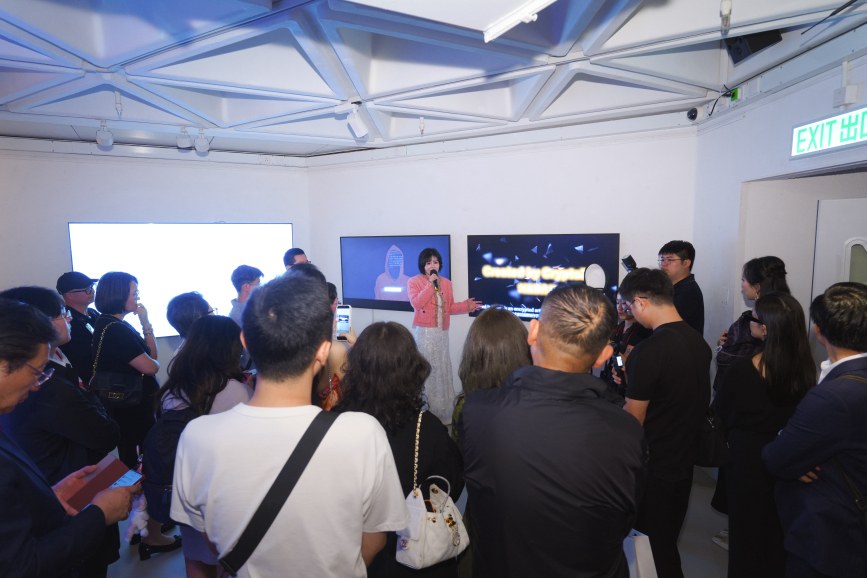
At the opening, Liu walked guests through her ideas herself. In a second Wen Wei Po report, she said she has lived in Hong Kong for two years, is studying in the EMBA program at the Chinese University of Hong Kong, and has been making crypto art for about nine years. She’s watching big data, AI and brain-computer interfaces, and believes almost anything can become art. Asked which of her works she likes best, she answered, “The next one!” Her reasoning: an artist needs a solid creative system that keeps upgrading, not one-off flashes of inspiration.
The same report said Sigg has visited her studio several times, and that curator Gu called her the “Crypto Queen” as a first-generation pioneer of the field. According to a Bastille Post blog post, the opening drew guests from politics, business and the arts, and Liu said building a stable, constantly upgraded creative system matters more than any single burst of inspiration.
She builds the platforms too
Liu isn’t just making the art. Wen Wei Po described her as the founder of crypto art platforms including TopBidder and BidderArt, and the show’s organizer was ZRDAO, with the Chinese University of Hong Kong among the co-organizers, per NFT Culture. Before the opening, a symposium with Gu, academics and LinkVC founder Lin Jiapeng dug into how crypto tech can change art royalties, liquidity and the way works are traded, Wen Wei Po reported.
Why Hong Kong? Liu told Wen Wei Po the city is where Eastern and Western art and capital meet, one of Asia’s more active places for Web3 talk, and a fit for an art form that sits where art, finance and tech cross.
The takeaway
CryptoZR’s lane isn’t hype, it’s systems. She took skills from her day job in product design, built work where the rules, the sale and the buyers’ behavior are the art, and then built her own platforms to sell it. You don’t need a $3 million drop to borrow the playbook. Give your collectors a role, like an open auction, a numbered run or a piece that changes with each buyer, and tell the story of how it works. Pick a city or scene where your audience already gathers. And treat your practice like a product that keeps shipping updates. When someone asks for your best work, the answer should be the next one.
Image: Bastille Post