
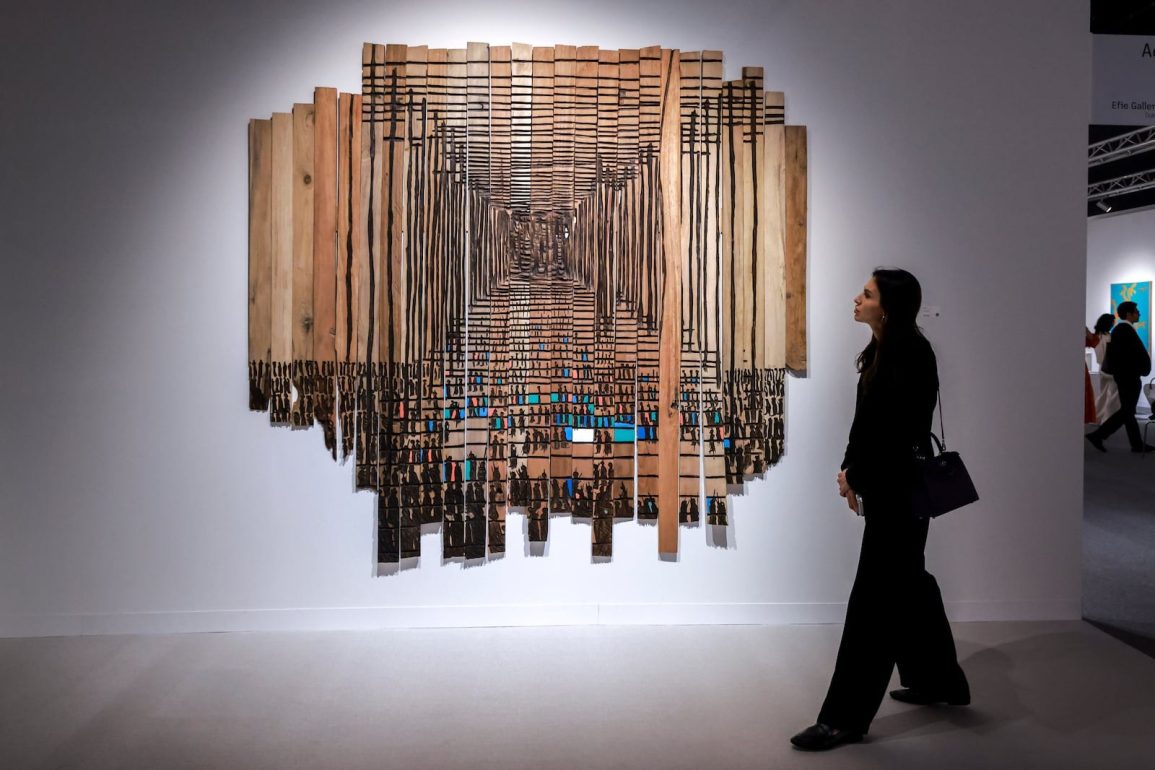
Frieze’s first fair in the Gulf opened with a war in the region and the big New York auctions pulling collectors away, and dealers still sold out booths, from $10,000 Emirati ceramics to a seven-figure ancient stele.
Missiles in the news, VIPs stuck in New York, and the art still sold. According to ARTnews‘s Hikmat Mohammed, Frieze Abu Dhabi opened this week as the war with Iran kept people nervous about traveling to the Gulf. The fair’s director, Dyala Nusseibeh, wasn’t worried. “It’s business as usual in Abu Dhabi,” she told ARTnews. “The collectors are spending and people are buying.”
On opening day she mostly had it right. The fair runs through today, Sunday, November 22.
Same fair, new owner
This isn’t exactly a brand-new event. According to Artnet‘s Margaret Carrigan, Frieze teamed up with Abu Dhabi’s Department of Culture and Tourism to replace Abu Dhabi Art, the state-backed fair founded in 2009, which had been struggling to reach institutional and international audiences. Frieze cut the floor from 142 galleries last year to 89, and around 40 percent of exhibitors come from West Asia, North Africa and South Asia, most of them showing regional artists.
The crowd is young, too. “A couple of years ago we did a quick data survey on who was coming to the fair, and over 70 percent of fairgoers were under 40,” Nusseibeh told Carrigan, calling it “quite an interesting opportunity” for growth.
Not everything went smoothly. Carrigan reported that some would-be visitors from the region couldn’t fly in because of suspended or delayed flights, and some VIPs from farther away canceled. “The geopolitics have been difficult,” Frieze CEO Simon Fox told her. “You can’t get everything right the first year, but we’re in this for the long haul.”
What actually sold
ARTnews reported that by late afternoon on opening day, Timothy Taylor had sold its whole solo booth of Hilary Pecis paintings, priced $65,000 to $205,000. Thaddaeus Ropac sold three Imran Qureshi works at $60,000 each to a UAE-based collection, and London antiquities dealer David Aaron sold a 2,000-year-old funerary stele to a private collector for a seven-figure sum. Dubai’s Taymour Grahne Projects sold out its booth of mosaics of 1970s Abu Dhabi architecture.
The more useful numbers are further down the price list. Abu Dhabi gallery Iris Projects brought six Gulf artists priced from $4,000 to $32,000, Artnet reported. ARTnews said UAE-based collectors bought two ceramics by Eman Al Hashemi at $17,000 and $15,000, an oil pastel by Dhabia Al Qubaisi for $10,500 and a photograph by Ammar Al Attar for $12,500. Dubai’s Lawrie Shabibi sold seven works by Hamra Abbas and Shaikha Al Mazrou, priced from $10,000 to $120,000.
Some buyers didn’t even wait for the doors. Carrigan reported that the royal family walked the fair a day early and took first pick, including all of Hamra Abbas’s inlaid gemstone pieces, with small still lifes at $10,000 and larger landscapes at $28,000 to $30,000.
The doubters
The fair landed the same week as the big New York evening sales. “Frieze is a diabolical date—all of us can’t go because we’re all in New York,” Philip Hoffman, founder of the Fine Art Group, told ARTnews. Artnet also warned that sales in the region move slower, and “sometimes holds never become transactions.”
There’s a bigger catch. According to The Art Newspaper‘s Melissa Gronlund, art from the Arab world is still underexposed and relatively cheap, and most artists from the Middle East and North Africa still sell mainly to buyers with ties to the region. Nusseibeh told the paper the UAE made up 45 percent of all buyers of that art in 2025. “We’re now ready for that next step outward—integrating the local and the regional market far better into the global market,” she said.
Who’s really paying
ARTnews reported that most of the big buying power will likely come from state funds and royal sources, and that the next test is building private buyers. “The next stage is about developing a much broader private collecting base,” said Mohammed Hafiz of Jeddah’s ATHR Gallery. Kourosh Nouri of Dubai’s Carbon 12 said private collectors are the ones “carrying galleries like ours.”
And the artists still grind. According to The National‘s Faisal Al Zaabi, Emirati artist Abdullah Al Saadi has spent a decade turning the sweet potato into sculpture, jewelry, furniture, a book and even an alphabet. He wants to build a monumental version, but said that would take financial and practical support. “Even after 10 years, I’m still working on this project,” he said. “It isn’t finished.”
The takeaway
Art fairs are chasing new money, and new money wants to see its own culture. Frieze went to the Gulf because collectors there are young, rich and buying, and the artists who did well were the ones whose work speaks to where they come from. Know who your local buyers are and make work that belongs to your place. Put real prices on your work: a lot of these sales landed between $10,000 and $35,000, not in the millions. Treat a hold as a maybe, not money in the bank. And build private collectors one at a time, because grants and institutions come and go, and the people who keep buying from you are the ones who carry you.
Image: The National