



Abstract
The social network is an important way to promote subjective poverty alleviation. Based on China Labor Dynamics Survey (CLDS) data from 2014, 2016, and 2018, this paper analyzes the action mechanism of social networks on the subjective poverty of Chinese residents. The results find that social network acts on subjective poverty through social support and reference groups. Specifically, social networks provide emotional and instrumental social support for individuals, which can effectively alleviate subjective poverty. In addition, when the social network members serve as the reference group, the higher the status of individuals in the network, the weaker the subjective poverty. Secondly, objective poverty is the mediating path between the social support function of social networks and subjective poverty. Finally, objective poverty is a regulator of the effect of social networks as a reference group on subjective poverty. When individuals are objectively poor, the alleviating effect of social networks as a reference group on subjective poverty is weakened. In summary, placing social networks’ social support and reference group functions under the same framework helps fully grasp social networks’ social benefits. As a result, consolidating China’s poverty reduction achievements and focusing on the informal social insurance role of social networks are conducive to alleviating subjective poverty.
Introduction
Realistic background
Statistics show that Chinese residents’ per capita disposable income rose from 16,510 yuan in 2012 to 36,883 yuan in 2022. The residents’ income level has dramatically improved since the 18th National Congress of the Communist Party of China (CPC), the material living standard has significantly improved, and the fight against absolute poverty has won greatly. The Fourth Plenary Session of the 19th Central Committee of the CPC emphasized relative poverty as an important task in future poverty governance. Relative poverty here refers to objective poverty. Meanwhile, with the development of society, China’s social contradiction has changed from the contradiction between the people’s growing material and cultural needs and backward social production to the contradiction between the people’s growing needs for a better life and unbalanced and insufficient development. Therefore, subjective poverty related to people’s subjective life experiences should also become an important part of poverty governance. However, relative poverty has received more attention in the current policy-making and governance practice, while subjective poverty needs more attention.
Theoretical background
There is much research on objective poverty in academia, experiencing a shift from absolute to relative (Decerf, 2021) and from unidimensional (Li and Cai, 2023) to multidimensional (Betti and Verma, 2008). The focus on subjective poverty stems from scholars’ reflections on objective poverty. They argue that, firstly, objective poverty studies adhere to an elitist perspective, in which social governors define the criteria for poverty based on a particular living standard, and that such a uniform standard-setting is helpful for poverty reduction policy-making and poverty governance in a generally low level of social development (Zuo and Yang, 2013). However, with social development, the rigid standard is not sensitive to social and economic development and needs to pay attention to the subjectivity of people experiencing poverty. Secondly, unidimensional objective poverty is mainly based on income and consumption to determine the poverty line. Although it has the advantage of simplicity and ease of implementation, scholars consider monotonous, changeable, inaccurate, and arbitrary as its main disadvantages (Alkire and Santos, 2013; Deaton and Heston, 2010). While overcoming many disadvantages of unidimensional measurement, multidimensional poverty suffers from difficulty obtaining data and insufficient attention to the emotional dimensions of poor objects (Lačný, 2020). Finally, there needs to be more focus on well-being. Unidimensional economic poverty focuses only on basic material satisfaction, whereas well-being is a holistic sense of life (Greve, 2008; Baltatescu, 2014). Although Sen’s underlying assumption of capability poverty is multidimensional, he neither provides a practical criterion for evaluating the ability to function nor does he seek any aggregation of the social value of these individual abilities (Kingdon and Knight, 2006), and therefore fails to compensate for the lack of attention to individuals’ well-being.
Subjective poverty takes individuals’ subjective perception of well-being as a starting point (Flik and van Praag, 1991). It allows them to assess their life satisfaction within a specific social reference frame (Gönner et al., 2007; Lačný, 2020). Thus, subjective poverty has an empowering nature. It demonstrates the humanitarian concern in academic research. In conclusion, subjective poverty expands the traditional criteria, breaks the monopoly of power in the identification of poverty, and fully empowers those identified with autonomy (Zuo and Yang, 2013), which is in line with the advocacy of respecting objects’ subjectivity in China’s poverty governance and rural revitalization strategy in the new era (Du, 2017). In summary, relativity, subjectivity, well-being, and poverty are the main characteristics of subjective poverty.
Academics have explored the relationship between subjective and objective poverty and analyzed the formation mechanism. Given the relationship between objective and subjective poverty, scholars generally agree that they are highly correlated but not symmetrical. Mahmood et al. (2019) find that objective and subjective poverty are not independent and have a strong correlation. However, the results of one-to-one correspondence between them include both poor, neither poor, subjective poor but objective non-poor, and objective poor but subjective non-poor. Wang et al. (2020) find a mismatch between subjective and objective poverty in rural China, and residents’ self-defined subjective poverty line is much higher than the official poverty line. In addition, the subjective poverty line of non-poor households is higher than that of poor households. These studies find that objective poverty is an important component of poverty, but not the whole of poverty, and that subjective poverty complements objective poverty (Zhao et al., 2023; Carletto and Zezza, 2006).
There are three ways to explain the formation mechanism of subjective poverty: relative income hypothesis, social inequality hypothesis, and multifactorial synthesis. The relative income hypothesis states that people’s self-perception about life is not only related to absolute indicators but also relative indicators such as relative income, especially relative to peers, are important (Duesenberry, 1949). For example, some scholars have found that even if a country’s objective poverty improves, subjective poverty does not alleviate or worsen if residents have a lower relative social status than others around them and if residents feel a stronger sense of deprivation (Carletto and Zezza, 2006). Some scholars (Fafchamps and Shilpi, 2008) further distinguish objective absolute and relative poverty and find that the alleviation of both favors subjective poverty alleviation. Still, objective relative poverty has a greater impact than absolute poverty. In addition, relativity involves comparison with one’s past (Alem et al., 2014). An individual’s experience of objective poverty affects their subjective perception of poverty in the long run, even if their objective living standard improves.
The social inequality hypothesis is related to, but also different from, the relative income hypothesis. Both are important variables for examining social structural constraints. Still, the former reflects the more macro-social structural state, while the latter presents the position of micro individuals under structural constraints. Moreover, alleviating social inequality affects an individual’s relative social position, affecting their subjective perception of poverty (Siposné Nándori, 2011). Studies have found that even if a country or region has achieved significant economic and social development, its subjective poverty will increase rather than decrease if it has high social inequality (Alem et al., 2014). However, other studies (Liao, 2021) have found that if inequality is low in an area, one can not clearly define their relative status, and the impact of relative status on subjective well-being will disappear. In contrast, subjective well-being is higher for groups that can make upward and downward comparisons in a region with a certain degree of inequality. The upward mobility hypothesis explains this phenomenon by suggesting that people tolerate present inequality and do not necessarily support equalizing redistributive policies because they expect themselves or their children to be part of a higher-income group in the future (Bénabou and Ok, 2001). In summary, the impact of social inequality on subjective poverty is complex.
The multifactorial synthesis theory integrates the dimensional factors. For example, Chan and Wong (2020) simultaneously focused on the impact of income, deprivation, and social exclusion on subjective poverty. In addition, demographic characteristics, household structure, employment, income, education, social network, and other variables have attracted scholars’ attention (Mahmood et al., 2019; Wang et al., 2020). However, the multifactorial synthesis needs more theoretical guidance, which needs to be revised to contribute to the theoretical construction.
Research review
To summarize, the existing studies still need to improve: first, paying attention to social networks as a structural factor is necessary. Both the relative income hypothesis and the social inequality hypothesis have examined the impact of social structural constraints on individuals’ subjective poverty, whereas relativity is usually the result of comparisons among social network members (Guo and Wang, 2019). Because network position represents and creates competitive advantage, it connects nodes with their occupants, resources, and information, constituting valuable capital (Lin, 2001). Therefore, the position of an individual in the social network determines the result of comparison to some extent and thus becomes an essential influence on subjective poverty. Therefore, examining the effect of social network members as a reference group on subjective poverty is also a refinement and extension of the relative income hypothesis. In addition, the most crucial function of social networks is to provide social support to help poor residents alleviate objective poverty (Chantarat and Barrett, 2012), while the alleviation of objective poverty helps alleviate subjective poverty (Fafchamps and Shilpi, 2008). Therefore, social networks will affect subjective poverty through social support and reference groups. However, previous studies have only focused on its role in objective poverty, ignoring its explanatory power on subjective poverty. Moreover, existing studies have paid more attention to the social support function of social networks and less to the function of reference groups, thus underestimating the social benefits of social networks.
To sum up, it is necessary to study subjective poverty from the social network perspective. First, analyzing the impact of social networks as a reference group on subjective poverty is also a refinement and extension of the relative income hypothesis, which can enrich the existing studies on subjective poverty. Secondly, simultaneously analyzing social networks’ social support and reference group mechanisms can help us understand social networks’ social benefits more comprehensively. Finally, it analyzes the formation mechanisms of subjective poverty. Studies have examined the relationship between subjective and objective poverty (Siposné Nándori, 2011), relative income (Carletto and Zezza, 2006), social inequality (Alem et al., 2014), and subjective poverty, ignoring the interaction mechanism between the factors. To sum up, analyzing the complex mechanism between objective poverty, subjective poverty, and social networks is necessary.
Research problems and innovations
Based on this, the research questions of this paper are: How do social networks affect subjective poverty? What role does objective poverty play in the relationship between social networks and subjective poverty? In summary, the innovations of this paper are as follows: (1) The social support and reference group functions of social networks are placed under the same research framework to analyze their mechanism on subjective poverty. (2) To deeply explore the role of objective poverty in the relationship between social networks and subjective poverty.
Analytical framework and research hypothesis
Analytical framework
Social support and comparison are important functions of social networks (Yue and Wang, 2022). Based on the trust and emotion generated by interpersonal communication, social network members are responsible and obligated to support each other, which can help them overcome difficulties and improve their quality of life (Lin, 2001), thus alleviating poverty. In addition, the comparison results with other social members will influence individuals’ subjective perceptions about their living standards (Clark, 2018). The comparative objects are usually individuals who have a stable connection with themselves (Merton, 1968). Social network members meet this requirement. Thus, they become essential reference objects. Therefore, social networks will influence individuals’ subjective poverty in two dimensions: social support and reference groups.
Studies have shown that social networks have a significant role in alleviating objective poverty when they serve as social support (Chantarat and Barrett, 2012), while the alleviation of objective poverty helps alleviate subjective poverty (Fafchamps and Shilpi, 2008). Thus, objective poverty mediates between the social networks’ support mechanisms and subjective poverty. Social comparisons with social network members influence subjective poverty. However, social network comparison is a subjective comparative result influenced by an individual’s objective living standard. When individuals are objectively poor, the effect of social comparison on subjective poverty will be weakened (Ravallion and Lokshin, 2010). Thus, objective poverty will moderate the impact of social networks on subjective poverty when they act as reference groups, which is the moderating mechanism of social networks. Thus, the social support and reference group mechanisms of social networks on subjective poverty and the mediating and moderating role of objective poverty constitute the overall research framework of this paper.
Research hypothesis
The direct effect of social networks on subjective poverty
First, social networks serve as social support. Studies have explained the role of social networks in social support from functional and structural perspectives. Scholars for the functional perspective argue that social capital embedded in social networks can provide individuals with diverse social support. Different kinds of social support will produce different social effects. Lin (2001) supports the functional perspective. He believes that actors’ actions to obtain resources from social networks include “expressive actions” and “instrumental actions.” The former mainly provides emotional support for individuals. For example, emotional communication helps individuals to relieve negative emotions, thus regulating physical and mental health and enhancing positive life experiences (Guo and Wang, 2019). The latter mainly provides material support for individuals, such as employment information, financial support, and life care. Scholars have studied the effects of emotional support on mental health or happiness and believe that emotional social support significantly impacts subjective emotional experience (Gong et al., 2021). Instrumental social capital alleviates subjective poverty by providing individuals with material support. Other scholars from the structural perspective investigate the role of social networks (Marsden, 1987). Zhao (2008) believes that the larger, more cohesive, and more homogenous social network is, the more emotional support it can provide for individuals and the more potent its predictive effect on mental health is. In contrast, a loose network with high heterogeneity can facilitate the flow of information, provide individuals with material and information support, and therefore have a greater impact on individuals’ physical health. In conclusion, the division of functional and structural perspectives fully demonstrates that social networks have social support functions.
In addition, Lin (2001) believes there are differences in the social consequences produced by different social supports. Instrumental actions aim to acquire new resources, increasing the individual’s material resources, and expressive actions aim to maintain existing resources, resulting in satisfying emotional experiences. In general, subjective life experiences are expressive actions. Therefore, emotional support of social networks significantly affects it more than instrumental support (INSC). Subjective poverty is a subjective perception of life. Therefore, social networks’ social support into emotional (ENSC) has a greater effect on subjective poverty than INSC.
Functional and structural orientations are both sides of the social network, but a functional perspective will more effectively distinguish the different social supports that social networks can provide. Therefore, from a functional perspective, this paper divides social networks’ social support ENSC and INSC and argues that both can effectively reduce individuals’ subjective poverty. Still, ENSC has a more vital role. It leads to the following hypothesis:
Hypothesis 1.1: Social networks’ emotional and instrumental suppot can effectively alleviate the subjective poverty of Chinese residents.
Hypothesis 1.2: Social networks’ emotional support in social networks has a stronger alleviation effect on subjective poverty than instrumental support.
Second, the social network members serve as reference groups. People are social, and the process of seeking self-cognition is also the process of comparing with others. Different reference groups selected in social comparison will produce differentiated self-cognition (Festinger, 1954). Therefore, the choice of the reference group is crucial. Goodman (1974) believes that the selection of reference groups depends on the information availability and relevance of reference objects. The former refers to the amount of information about the reference object used to form judgments about self and others. The latter refers to comparabilities, such as social status, demographic characteristics, and social distance from the reference object. Social network members meet the information availability and relevance and thus become an essential reference group for social comparison (Guo and Wang, 2019). An individual’s relative position in the social network forms the basis of self-evaluation, which further influences their subjective experience of life (Gartrell, 1987). When an individual is in a dominant position in the social network, they will have a sense of satisfaction and superiority, leading to a higher self-evaluation and a perception of being non-poor. When an individual is in an inferior position in the social network, they will have a sense of deprivation (Yue and Wang, 2022), leading to a lower self-evaluation and a belief that they are poor.
In addition, individuals are embedded in different social networks and will have different subjective emotional experiences compared to the different social network members (Wu and Wang, 2017). According to the literature review, social comparison includes parallel, downward, and upward social comparisons. Among them, similarity is the basic characteristic of the reference object of parallel comparison. It leads to the homogenous comparison hypothesis (Wu and Wang, 2017), which states that individuals prefer to compare themselves with homogeneous individuals because they can provide more information (Festinger, 1954). Lin’s (2001) homophily hypothesis also suggests that people prefer to socialize with people who are similar to them regarding social status and lifestyle, also known as the “like me” hypothesis. Moreover, individuals tend to care more about the opinions of those close to them, i.e., focus on homogenous comparisons. It determines that homogenous comparisons dominate social comparisons (Wu and Wang, 2017). As a result, homogeneity comparisons are more common and have stronger effects (Suls and Wheeler, 2000). However, one also makes comparisons of heterogeneity. When they need self-improvement, they are more inclined to make upward comparisons. The reference objects are often individuals who are superior to themselves in some aspects, modeling self-improvement after them (Goethals and Darley, 1977), which is also known as the upward mobility expectation hypothesis (Bénabou and Ok, 2001). Individuals motivated by self-satisfaction tend to make downward comparisons, where their referents lag behind them somehow (Suls and Wheeler, 2000). So, upward and downward comparisons are made to individuals who differ. We take upward and downward comparisons as heterogeneous, drawing on the concept of the homogeneous comparison hypothesis.
In a network composed of ascribed relationships (such as kinship, geographical relationship, etc.), members have high similarity in terms of social status, life habits, etc. (Lin, 2001), and their interaction frequency, emotional intensity, intimacy, and reciprocity are all high (Granovetter, 1973). The related attribute information among network members is easier to obtain and more comparable. For a weak relationship, members differ greatly in social status and life habits and have strong heterogeneity (Lin, 2001). Their interaction frequency, emotional intensity, intimacy, and reciprocity are much lower than those of homogenous network members. Although information about weak relationship members is available through social networks, information related to income, poverty, etc., is highly private and has low accessibility. In conclusion, the comparability of heterogeneous network members formed based on weak relationships is lower than that of homogenous network members, so its predictive effect on subjective poverty is weak. Based on this, we propose the following hypotheses:
Hypothesis 1.3: Compared with individuals with low status in homogeneity or heterogeneity social networks, individuals with high status have lower subjective poverty.
Hypothesis 1.4: Homogenous social network comparison (HONC) has a more significant predictive effect on subjective poverty than heterogeneous social network comparison (HENC).
The mediating mechanism
The social network can provide diversified social support for individuals to improve their living standards and reduce objective poverty. Specifically, the paths of social networks’ effects on objective poverty are as follows: from a functional perspective, the social network can provide individuals with different social support to alleviate objective poverty (Hill et al., 2021). For example, providing heterogeneous employment information improves the efficiency of human-job matching and increases economic income (Granovetter, 1973). Income is the basic resource to alleviate objective poverty (Li and Cai, 2023). Furthermore, social networks can play the role of informal insurance to help low-income families resist external shocks and risks, improve risk avoidance ability, and thus alleviate poverty (Matthews and Besemer, 2014). In addition, from a structural perspective, some scholars compare the differences in the effects of different social networks on objective poverty, and the results show that social networks with higher homogeneity can provide less social support than those with higher heterogeneity (Zhang and Fang, 2021). In summary, structural and functional studies show that social networks’ social support function can alleviate objective poverty. In addition, although the relationship between objective poverty and subjective poverty is not symmetrical, studies have shown a significant positive correlation between them, i.e., objective poverty alleviation favors subjective poverty alleviation (Mahmood et al., 2019; Wang et al., 2020). Therefore, objective poverty is the mediating variable between social support mechanisms of social networks and subjective poverty. Combined with hypotheses 1.1 and 1.2 above, we propose the following hypotheses:
Hypothesis 2.1: Objective poverty mediates between social networks’ emotional support and subjective poverty.
Hypothesis 2.2: Objective poverty mediates between social networks’ instrumental support and subjective poverty.
Lin (2001) believes that individuals’ instrumental actions in social networks aim to acquire new resources, promoting increased material resources, while expressive actions mainly provide emotional comfort. The lack of material resources is the main cause of objective poverty (Metz, 2016). Therefore, INSC has a more significant mitigating effect on objective poverty than ENSC. In conjunction with the above, higher levels of objective poverty alleviation produce stronger subjective poverty effects. Therefore, the mediating effect is more significant in the mediating path of INSC, proposing the following hypothesis:
Hypothesis 2.3: The mediating effect of objective poverty between social networks’ instrumental support and subjective poverty is more significant than that between emotional support and subjective poverty.
The moderating mechanisms
The relative income hypothesis is an important explanatory mechanism for subjective poverty. Some studies have shown that relative income, compared with the reference group, is an important factor influencing subjective poverty, and its influence is more significant than absolute income (Siposné Nándori, 2011). In line with this, objective relative poverty has a greater impact on subjective poverty than absolute poverty (Fafchamps and Shilpi, 2008). Moreover, some studies (Ravallion and Lokshin, 2010) have found that the effect of relative income on subjective poverty changes with objective poverty state. Specifically, objective poor residents are more concerned with absolute income, but non-poor residents pay more attention to relative income. It shows that when individuals are objectively poor, the survival resources represented by absolute income have a greater impact on subjective poverty. However, as income rises and objective poverty alleviates, relative income compared to the reference group will have a more significant subjective poverty effect (Kingdon and Knight, 2006). The above results show that absolute status influences relative status’s role on subjective poverty. However, both absolute and relative income and absolute and relative poverty in the above results are measures of objective indicators. Social comparisons are not only the result of objective living standard comparisons but also include subjective perceptions of living standards based on objective comparisons. Thus, subjective perception derives from and is influenced by objective reality, regardless of whether it is an absolute or relative status. When an individual’s objective living conditions are more favorable, the result of the subjective comparison will be better, and the subjective poverty perception will be lower. To this paper, when an individual is objectively poor, the comparison with social network members is poorer, producing a higher subjective perception of poverty. In sum, objective poverty moderates the effect of social networks on subjective poverty when they are used as reference groups. Combined with hypotheses 1.3 and 1.4 above, we propose the following hypotheses:
Hypothesis 3.1: Objective poverty moderates the predictive effect of homogeneous network comparisons on subjective poverty, and the effect of homogeneous network comparisons on subjective poverty is stronger for objectively non-poor residents than for objectively poor residents.
Hypothesis 3.2: Objective poverty moderates the predictive effect of heterogeneous network comparisons on subjective poverty, and the effect of heterogeneous network comparisons on subjective poverty is stronger for objectively non-poor residents than for objectively poor residents.
In summary, Fig. 1 presents the analytical framework of this paper.
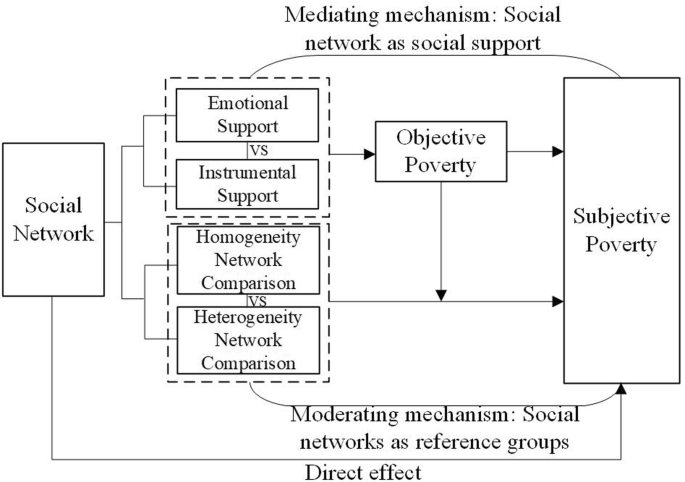
The figure shows how social networks as social support and reference groups influence subjective poverty and what role objective poverty plays between them. Where boxes represent variables, lines represent associations between variables, and arrows represent pointing relationships.
Data, variables, and models
Data
The data used in this paper were from the CLDS conducted by the Social Science Survey Center of Sun Yat-sen University, which adopted a multi-stage, multi-level, probability sampling method proportional to the scale of the labor force. The project was conducted in China in 2012, 2014, 2016, and 2018 in 29 provinces, municipalities, and autonomous regions (except Hong Kong, Macao, Taiwan, Tibet, and Hainan). The survey included community, household, and individual levels, including demographic, employment, economy, society, psychology, health, etc. Since many variables in this study were not collected in 2012, we used the 2014, 2016, and 2018 data. In addition, since the objective poverty measurement used the data at the household level, we combined the household and individual-level data, and each household only retained the individual questionnaire of the householder. After deleting the samples with missing variables, the final sample scale is 32,257.
Variables
Dependent variable
The dependent variable is subjective poverty. Subjective poverty line and subjective well-being are the main measures of subjective poverty. The subjective poverty line inherits the logic of the objective poverty line, which considers subjective poverty as subjective economic stress resulting from insufficient household economic income (Whelan and Maître, 2009) and has various operationalized approaches depending on the method of questioning.Footnote 1 Some scholars believe that the subjective poverty line can not effectively measure the holistic well-being of residents (van Praag et al., 2003). But, most scholars agree that well-being is an important feature of subjective poverty (Rojas, 2004).
The subjective well-being of poverty holds that the connotation of poverty includes economic and other dimensions of social life. Therefore, subjective poverty should include the perception of household income and the other dimensions of life. Subjective well-being and life satisfaction are comprehensive evaluation indicators of life quality, and their connotations include variables corresponding to physical and social functions (Kingdon and Knight, 2006). Therefore, some scholars use happiness, subjective well-being, and life satisfaction to measure subjective poverty, which is called subjective well-being poverty (Rojas, 2004). In addition, to reflect the multidimensionality of subjective well-being poverty, some scholars distinguish different life domains and measure the satisfaction of each domain separately, thus generating General Satisfaction Questions (GSQs) (van praag and Ferrer-i-Carbonell, 2008). The above measures have become common indicators of subjective poverty, and some studies have found that measurement based on subjective well-being is more consistent with objective poverty than the subjective poverty line method (Lokshin et al., 2006). The ladder approach is a common operationalization of subjective well-being poverty. It visualizes poverty as a hierarchical ladder, allows research participants to choose which rung they are on (Cantril, 1965), and is widely used (Ravallion and Lokshin, 2010).
Scholars questioned the subjective well-being poverty more and generally believe that subjective poverty does not mean dissatisfaction or unhappiness (Mahmood et al., 2019). Moreover, Sen (1983) argues that subjective well-being reflects specific psychological responses to using an ability rather than the ability itself. To compensate for the shortcomings of the above two measures, some scholars use subjective socioeconomic status as an operationalized indicator of subjective poverty (Sy, 2013; Tian et al., 2019). Subjective socioeconomic status is a complex and multidimensional concept that measures objective dimensions (e.g., income, education, occupation, etc.) and individuals’ subjective evaluation of their position on the socioeconomic spectrum (Navarro-Carrillo et al., 2020). Thus, subjective socioeconomic status is a better response to an individual’s subjective perception of their well-being while avoiding the problem of overly broad measures of subjective well-being.
Combined with the above analysis, referring to the research of Sy (2013) and Tian et al. (2019), this paper used subjective socioeconomic status to measure subjective poverty. The specific measure was based on Cantril’s (1965) ladder method. The question reads: “In our society, some people are at the top, and others are at the bottom. On a card like the one below, there is a ladder from top to bottom, with the highest “10” representing the top rung and the lowest “1” representing the bottom rung. Which rung do you think your household is on?”. The options for this question are 1–10; the larger the value, the higher the socioeconomic status. We set the options in reverse, with higher values representing higher degree of subjective poverty. In the robustness test, subjective poverty was a binary categorical variable. Referring to Carletto and Zezza (2006), the survey objects selected 1 and 2 in the original data were regarded as poor and assigned a value of 1; those selected 3–10 were regarded as non-poor and assigned 0. The proportion of subjective poverty in the full sample is 14.9%, and the mean of subjective poverty degree in the full sample is 6.586, 6.074 in the subjective non-poor sample, and 9.52 in the subjective poor sample.
Independent variables. The main independent variables were social networks. Social networks as social support. The social network size is an important measurement indicator of social networks (Flap and de Graaf, 1986). Siette et al. (2021) find that social network size is one of the most commonly used indicators when measuring the social network. Currently, the mainstream measurement methods of social networks include name-generating and position-generating methodologies (Maness, 2017). The name-generating methodology involves creating a list of participants’ networks, thus obtaining a sample of the respondents’ social relationships. It is a person-focused methodology. The method will yield quantitative and qualitative data on the respondents’ social networks. The position-generating methodology systematically samples a list of jobs within a social hierarchy (Lin and Dumin, 1986). The respondents are asked whether they know someone in that sampled position. The position-generating methodology is structure-focused. Empirical research has verified that the two methods can measure individuals’ social networks well.
However, they can’t effectively distinguish the types of social support social networks provide. Therefore, Van Der Gaag and Snijders (2005) propose a resource generator methodology devoted to measuring the types and quantity of available resources in social networks. Specifically, they asked whether anyone in their social network (acquaintances, friends, family) could provide a certain type of support (including 37 needs), then divided the required support into four categories: prestige and education, entrepreneurship, skills, and personal support. This method is a good attempt to measure social network capital from a functional perspective. However, its disadvantage is that it only measures whether a certain kind of support exists in different networks and can not effectively measure the size. Puccia et al. (2021) divided social support in social networks into expressive and INSC according to Lin’s division, combined with Van Der Gaag’s resource generator method to classify the social support that college students obtain from social network members (classmates, teachers, parents, etc.) into instrumental (specific advice and resources) and expressive support (emotional support and encouragement). The results find that parents’ social support produced the strongest impact among the social network members. In particular, parents’ expressive support had a greater impact than INSC. This article also measures the types of social support social network members provide from a functional perspective and compares its impact. They both have in common that they give social network members and then ask if they can offer a certain type of support. So, they focus on the types of social support different social network members provide. Our paper also attempts to investigate the types of social support social network members provide from a functional perspective. However, we focus on the amount of a particular type of social support an individual has access to rather than who provides it.
We drew on the resource generator methodology to ask respondents about their emotional and instrumental social network size to measure the social support from social networks. The former asked: “How many of these close local people can you talk to about your problems? “ The latter asked: “How many of these close local people can you borrow money from ($5000 is the standard)? “ As individuals’ social network size varied greatly, we took the logarithms.
Table 1 shows that the full sample mean of INSC is 1.041, 1.082 for the non-poor sample, and 0.809 for the poor sample, with significant differences between them. The full sample mean of ENSC is 1.156, 1.192 for the non-poor sample, and 0.949 for the poor sample, with significant differences between them. It indicates that the social network size of the non-poor sample is higher than that of the poor sample.
Social networks serve as reference groups. The information availability and relevance are important criteria for the homogenous comparison hypothesis. However, there still needs to be a consensus on the operationalization. Some scholars regard network members formed based on geography and kinship as reference groups for HONC (Firebaugh and Schroeder, 2009). Some scholars take people with comparable socioeconomic status (e.g., comparable levels of education) as the main reference group for HONC (Dynan and Ravina, 2007). In China, members in a social network based on ascribed relations such as kinship and geography are similar and highly homogenous regarding socioeconomic status and lifestyle (Lin, 2001). In addition, according to the above analysis, classmates with the same level of education are also an important component of the HONC. Therefore, we considered relatives, neighbors, and classmates with the same level of education as homogeneous network members. Except for the above members, all other network members have higher heterogeneity. Specifically, HONC used the question “Do you think your current living standard is better or worse than that of your relatives/neighbors/old classmates with the same level of education?” to measure. Summed and averaged the three questions as a result of the HONC. The answers for the above items are 1–5, from “much lower” to “much higher,” with a larger value indicating a higher network status. HENC used the question: “Do you think your current living standard is better or worse than that of other members in your municipal district?” to measure. Since this item allows respondents to choose “other members” by themselves, people usually regard individuals they know but have weak relationships as “other members,” which is consistent with the characteristics of heterogeneous comparison. The answers to the questions were 1–5, ranging from “much lower” to “much higher.” The larger the value, the higher the network status.
Table 1 shows that for HONC, the mean of the full sample is 2.737, the non-poor sample is 2.811, and the poor sample is 2.311, indicating a significant difference between them. For HENC, the mean of the full sample is 2.469, the non-poor sample is 2.549, and the poor sample is 2.009, indicating a significant difference between them. Comparing the results of HONC and HENC reveals that individuals generally have a higher status in the homogeneous network than in the heterogeneous network.
Moderating and mediating variables
Objective poverty is a mediating variable when social networks serve as social support and a moderating variable when social networks act as a reference group. Specifically, objective poverty in this paper mainly refers to objective relative poverty. The more common objective relative poverty measurement method is the “income ratio method” (Zheng, 2001): use a certain proportion of the median per capita disposable income to divide relative poverty. The proportion is usually 60% in developed countries and 40% in China. Moreover, there are large urban-rural differences in China. Although China won the fight against poverty successfully in 2020, the income gap between urban and rural residents is still large, making it inappropriate to adopt the same relative poverty line in the short term (Wang and Liu, 2020). Meanwhile, given the large scale of the mobile population in China, income tends to be closely linked to the economic development of their permanent residence. Therefore, this paper used the urban and rural types where the respondents lived as the indicator to divide urban and rural and took 40% of the median per capita disposable income as the poverty line.
Households with per capita income less than 40% of the median per capita disposable income are labeled as “poor” and assigned a value of “1”; otherwise, they are labeled as “non-poor” and assigned a value of “0, “ thus generating objective poverty. Descriptive statistics show that the proportion of objective poverty is 29.1% in the full sample, 26.9% in the subjective non-poor sample, and 41.3% in the subjective poor sample, with significant differences.
Control variables
In addition to the above core variables, other variables that might affect subjective poverty were also controlled in this paper, including gender, age, marital status, years of education, annual income, urban or rural type where the respondents live, political status, region (divided into central, eastern and western), survey year, migration experience, social insurance, and sense of fairness. Table 1 lists descriptive statistics for all variables.
Model (Some parameters are not shown in the introduction of the model, such as the coefficients the control variables.)
The dependent variable in this paper is a continuous variable ranging from 1 to 10. The benchmark model is OLS, estimated using the least squares method, followed by mediating and moderating effects models for mechanism analysis. The models are as follows.
where Y is the dependent variable subjective poverty, ({alpha }_{1}) is the constant term, Xi is the vector of control variables, where i = 1, 2, 3, 4, 5, 6, 7, 8, 9, 10, 11, 12, and ({alpha }_{2i}) is the parameter for each control variable. Sj is the social network, where j = 1, 2. When the independent variable is the social support of the social network, j is the INSC and ENSC, respectively. When the independent variable is the reference group, j is HONC and HENC, respectively.
In Eq. (2), P denotes objective poverty and is a binary variable, so use the logit model to estimate. b1 is the constant term; Xi is the vector of control variables, where i = 1, 2, 3, 4, 5, 6, 7, 8, 9, 10, 11,12, and b2i is the parameter for each control variable. Sj is the social network, where j = 1, 2 represents the INSC and ENSC, respectively, and ({b}_{3j}) is the parameter for the social network. ({b}_{3j}) significance is a necessary condition for the existence of the mediating effect. ε2 denotes the error term.
In Eq. (3), put the social support of the social network and objective poverty simultaneously. α4 significance is a necessary condition for the existence of the mediating effect.
Equation (4), Mk denotes the social networks as the reference groups. In this case, k = 1, 2, respectively, represents HONC and HENC and ({alpha }_{5k}) is the parameter. (Past {M}_{k}) represents the interaction term between objective poverty and the social network. ({alpha }_{6k}) is the parameter for the interaction term. Same as above for other meanings.
Results
The direct effect of social networks on subjective poverty
First, social support mechanisms
Table 2 shows the effect of social support mechanisms of social networks on subjective poverty. Model 1 puts in both the INSC and ENSC, and the results show that both coefficients are negative and significant, indicating that they can effectively alleviate the subjective poverty of Chinese residents, verifying Hypothesis 1.1. Further comparison shows that the coefficient of INSC is greater than ENSC’s, with a significant difference, falsifying Hypothesis 1.2.
There may be a bidirectional causality between social networks and subjective poverty. On the one hand, social support provided by social networks can help alleviate subjective poverty. Meanwhile, individuals with subjective poverty may be reluctant to communicate due to low self-cognition, so their social network size is small and can provide less social support.
To overcome this endogeneity problem, we used two instrumental variables. First, we drew on the studies of Wang and Zhang (2022) and Yin et al. (2023) to take the mean of other residents’ social network size at the village-level (excluding themselves) as an instrumental variable. On the one hand, village-level social networks are related to an individual’s social networks and meet the correlation requirements of instrumental variables. On the other hand, village-level social networks do not directly affect the subjective poverty of individuals.
Moreover, we drew on the studies of Lin et al. (2016) that adopted ordinary languages (Mandarin and dialects) as an instrumental variable of social networks. Specifically, considering that INSC has a higher requirement for network heterogeneity (Lin, 2001), and the respondents’ Mandarin fluency (1–5, continuous variable) is highly correlated with the heterogeneity of individuals’ social interaction, with the more fluent in Mandarin, the more heterogeneous network members they connect. Therefore, we took Mandarin fluency as an instrument variable of INSC. ENSC is often based on strong ties, which often come from kinship and geographical relations and usually communicate in dialects. Therefore, the higher the incidence of dialect communication during off-duty hours, the closer the workplace is to the hometown, and the richer the ENSC is. Therefore, we took the language used during off-duty hours (Mandarin = 1, dialect = 0) as an instrumental variable for ENSC. The above analysis illustrates the correlation between language and social networks. In addition, language, as a communication tool, does not directly affect the subjective poverty of individuals and is exogenous.
To test the validity of the instrumental variable, we conducted a series of tests, and Models 2 and 4 in Table 2 show the results. Model 2 is the first stage regression result of 2SLS for INSC. First, the endogeneity test. Use the Hausman test to test the endogeneity of INSC, and the result shows that the P-value is less than 0.001, indicating that INSC is an endogenous variable. It is necessary to use the instrumental variable method to correct it. The second is the weak instrumental variable test. The Cragg-Donald Wald F statistic is 1249, much higher than the critical value of 19.93 at the 10% bias level. It rejects the null hypothesis that endogenous variables are uncorrelated with the instrumental variable and indicates no weak instrumental variable problem exists. The Kleibergen-Paaprk Wald F statistic is 1280; in addition, the F-value of the first stage is 321, which proves that there is no weak instrumental variable problem. Third, the unidentifiable test. The p-value corresponding to the Kleibergen-Paap rk LM statistic is significant at the 1% level, strongly rejecting the null hypothesis of “unrecognizable,” the instrumental variable meets the basic requirement of holding the rank condition. Finally, the exogeneity test of instrumental variables. The P values corresponding to the Sargan and Hansen J statistics are greater than 0.1, indicating that the two instrumental variables are not correlated with the error term and are exogenous. The coefficients of the instrumental variables on INSC in Model 2 are positive and significant, which indicates that the instrumental variables are valid.
Using village-level social networks and off-duty language as instrumental variables for ENSC shows that off-duty language has no significant effect on ENSC, indicating that the instrumental variable does not meet the correlation hypothesis and is invalid. The results of INSC show that village-level social network is an effective instrumental variable. Therefore, we only use the village-level social network as an instrumental variable of ENSC for testing (as shown in Model 4), and the results show that this instrumental variable passes all tests, indicating that it is an effective instrumental variable of ENSC. The coefficient of the instrumental variable on ENSC in Model 4 is positive and significant, which indicates that the instrumental variables are valid.
Models 3 and 5 show the second-stage regression of 2SLS. The coefficients of INSC and ENSC are negative and significant, suggesting that for each unit increase in INSC and ENSC, the subjective poverty of Chinese residents will decrease by 0.483 and 0.213 units, respectively. Meanwhile, compared with the unadded instrumental variables, after adding the instrumental variables, the absolute value of the coefficients becomes larger, suggesting that disregarding endogeneity underestimates the effect of INSC and ENSC on subjective poverty. Model 6 compares the effects of INSC and ENSC after adding instrumental variables. The coefficients are negative and significant, and the absolute value is larger than in model 1. Further comparison reveals that the absolute value of ENSC’s coefficient is much larger than that of INSC, indicating that the alleviating effect of ENSC on subjective poverty is greater than that of INSC. Specifically, when both INSC and ENSC act on subjective poverty, for every unit increase in INSC, subjective poverty decreases by 0.259 units. For each unit increase in ENSC, subjective poverty will decrease by 0.289 units. Hypothesis 1.2 is verified, and the results of Model 1 are revised. Not considering endogeneity will underestimate the effect of ENSC on subjective poverty.
Second, reference group mechanism
Table 3 shows the impact of the reference group mechanism of social networks on subjective poverty. Model 1 includes the results of HONC and HENC. Both coefficients are negative and significant, indicating that for each unit increase in HONC, Chinese residents’ subjective poverty will decrease by 0.721 units. Meanwhile, for each unit increase in HENC, Chinese residents’ subjective poverty will decrease by 0.268 units. It indicates that the better the comparison results with network members, the weaker the subjective poverty, which tests Hypothesis 1.3. Further coefficient comparison shows that the coefficient’s absolute value of the HONC is greater than that of HENC, and the coefficient difference is significant. Hypothesis 1.4 is verified.
A bidirectional causal relationship between HONC and HENC and subjective poverty may exist. On the one hand, social network comparison can affect individuals’ subjective poverty; conversely, poor individuals tend to have lower self-evaluation, resulting in lower self-comparison outcomes. We use the instrumental variable method to overcome the endogeneity problem. The homogenous network comparison uses the mean of network members’ comparisons at the village-level (excluding themselves) as the instrumental variable. Since the heterogeneous network comparison is within a municipal district, we use the mean of other members’ comparisons at the province level (excluding themselves) as the instrumental variable. Conversely, macro-level social network comparison results affect individual social network comparison results. On the other hand, macro-level social network comparison results do not directly affect an individual’s subjective poverty.
We use the same method as above to test the instrumental variables, and both the test results and the first stage regression results (Models 2 and 4) show that the instrumental variables of HONC and HENC are effective. Models 3 and 5, respectively, show the result of HONC and HENC after adding instrumental variables, and the coefficients’ absolute values of both are greater than those of model 1, suggesting that disregarding endogeneity will underestimate the effects of HONC and HENC on subjective poverty, which test Hypothesis 1.3 again. Model 6 puts in both HONC and HENC, and the result shows that HONC is still negative and significant, and HENC is no longer significant. It suggests that HONC has a more robust effect on subjective poverty, again testing hypothesis 1.4.
The mediating mechanism
Social networks can provide emotional and instrumental support for individuals to alleviate objective and subjective poverty.
According to the above analysis, there is also a bidirectional causal relationship between social networks and objective poverty, and the mean of social networks at the village-level and ordinary language can also be used as instrumental variables of social networks to solve this endogenous problem. Therefore, we add instrumental variables to the mediation effect analysis. Table 4 shows the results. Models 1–3 show the results when INSC is the dependent variable, and Models 4–6 show the results when ENSC is the dependent variable. Model 1 takes subjective poverty as the dependent variable, and the results show that the coefficient of INSC is negative and significant, indicating that for each unit increase in INSC, the subjective poverty of Chinese residents will decrease by 0.483 units. When objective poverty is the dependent variable in Model 2, the INSC plays a negative and significant role, indicating that for each unit increase in INSC, Chinese residents’ objective poverty incidence ratio will decrease by 45.77% (e-0.612-1). Model 3 takes subjective poverty as the dependent variable; when it adds objective poverty, the coefficient is positive and significant, indicating that subjective poverty will increase by 0.316 units when residents are objectively poor. At this point, the INSC is still negative and significant. Still, the coefficient’s absolute value becomes smaller, indicating that objective poverty is the mediating variable between INSC and subjective poverty. By calculation, the proportion of indirect effect is 12.42%, and the proportion of direct effect is 87.58%, verifying Hypothesis 2.1.
Models 4–6 in Table 4 show results on the mediating path of ENSC. Model 4 takes subjective poverty as the dependent variable; the coefficient of the ENSC is negative and significant, indicating that the subjective poverty of Chinese residents will decrease by 0.482 units for each unit increase of ENSC. When objective poverty is the dependent variable in Model 5, the ENSC plays a negative and significant role, indicating that for each additional unit in ENSC, the objective poverty incidence ratio of Chinese residents will decrease by 19.02% (e-0.211-1). Model 6 takes subjective poverty as the dependent variable; when adding objective poverty, the coefficient is positive and significant, indicating that when the residents are objectively poor, the subjective poverty will increase by 0.346 units. At this point, the ENSC is still negative and significant. Still, the coefficient’s absolute value becomes smaller, indicating that objective poverty is the mediating variable between the ENSC and subjective poverty. By calculation, the proportion of indirect effect is 4.77%, and the direct effect is 95.23%, verifying Hypothesis 2.2.
The above results show that the mediating effect of objective poverty is small, and the social support of social networks mainly directly affects subjective poverty. Further comparison of the mediating effect on the INSC and ENSC paths reveals that INSC paths are greater than ENSC, and Hypothesis 2.3 is verified.
Moderating mechanisms
The effects of HONC and HENC on subjective poverty are moderated by objective poverty, as shown in Table 5. Models 1 and 2 are the results without adding instrumental variables, and models 3 and 4 are the results after adding instrumental variables. Model 1 demonstrates the interaction effect between HENC and objective poverty. Model 2 shows the results of the interaction effect between HONC and objective poverty. The interaction terms are positive and significant in both models, and the main effects are negative and significant, suggesting that objective poverty weakens the effects of social network comparisons on subjective poverty. When Chinese residents are objectively poor, the predictive effect of HONC and HENC on subjective poverty decreases, verifying Hypotheses 3.1 and 3.2. Models 3 and 4 are the results after adding instrumental variables. The results are consistent with models 1 and 2, and the coefficients of interaction terms become larger, indicating that the moderating effect will be underestimated without considering endogeneity.
Robustness test
We test the robustness of these results by replacing variables and models. We use the IVProbit model to test the hypotheses by replacing the subjective poverty degree with the state of subjective poverty. Figure 2 shows the results. Model 1 tests the effect of social networks’ social support function on subjective poverty. The results show that after adding instrumental variables, the effect of ENSC on subjective poverty remains negative and significant. INSC is no longer significant, suggesting that ENSC has a more robust effect on subjective poverty, consistent with the above. Model 2 tests the effects of HONC and HENC on subjective poverty. The results show that the effect of HENC on subjective poverty is no longer significant after adding instrumental variables, and HONC remains negative and significant, consistent with the above. We further tested the moderating mechanism of objective poverty, and the results are consistent with the above.
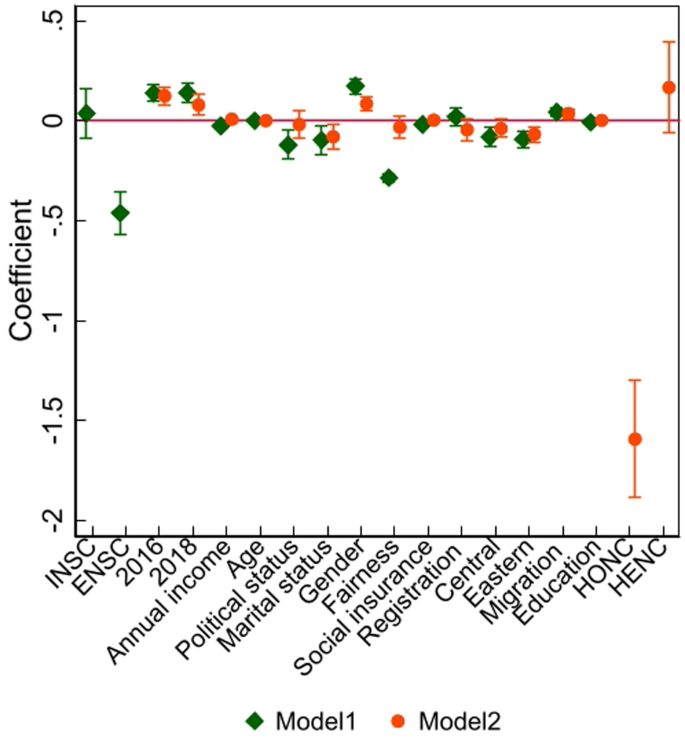
In this figure, the abscissa is the independent variable, and the ordinate represents the coefficient of the influence of the independent variable on the dependent variable. Green represents the results of the variables in Model 1 and red represents the results of the variables in Model 2.
Further, the use of the KHB method decomposes the mediating role. The KHB method is an effective method to decompose mediation effects. The main advantage of this method is that it can separate the influence of discrete and continuous variables through simple and intuitive calculation and extend the factorability of linear models to nonlinear probabilistic models. At the same time, it can also be used for complex mediation models with multi-dependent variables and independent variables. Therefore, it becomes one of the important methods to decompose mediating variables. And the results, as shown in Table 6, are consistent with those above. In conclusion, the findings are robust.
Conclusion and discussion
China’s poverty governance has entered a new stage in the new period. Objective relative poverty and subjective poverty should become new goals of poverty governance under common prosperity. Social networks are important mechanisms for poverty reduction. In this paper, we analyze the influence of social networks on subjective poverty and the action mechanism of objective poverty by using the CLDS data in 2014, 2016, and 2018.
Conclusion
First, social networks are an important factor influencing subjective poverty, and their influence paths are social support and reference groups. Social networks provide individuals with instrumental and emotional support; both can alleviate individuals’ subjective poverty, but ENSC plays a more significant role than INSC. Social network members are also essential reference objects for social comparison. The higher the individual’s status in the social network, the lower the subjective poverty. HONC has a more significant subjective poverty reduction effect than HENC. Second, objective poverty regulates the role of social networks’ reference group mechanism on subjective poverty. When individuals are objectively poor, social networks’ reference effects on subjective poverty weaken. The result is consistent across HONC and HENC. Third, objective poverty is the mediating mechanism between the social support function of social networks and subjective poverty. Moreover, the indirect effect on the mediating path of INSC is greater than ENSC.
The main contributions
First, it simultaneously analyzes the social network’s social support and reference group mechanism. The poverty reduction effect of social networks as social support has become a classic topic of academic debate (Böhnke and Link, 2017). However, the function of social networks as a reference group has yet to receive enough attention. The social network members conform to social comparison’s relevance and information availability principles (Goodman, 1974), so they are the ideal reference objects. However, there are few studies on the social network as a reference group to subjective emotional experiences. This paper places the two mechanisms in an analytical framework to verify their predictive role on subjective poverty, which is conducive to an in-depth understanding of the social benefits of social networks. At the same time, existing studies take social networks as a whole (Matthews and Besemer, 2014). Still, individuals are often embedded in different types of networks (Lin, 2001), and network types distinguished from different perspectives often produce different social consequences. From a functional perspective, we divide social support in social networks into emotional and instrumental. From a structural perspective, we compare the differences in social networks’ reference group effects. In summary, we verify and enrich the theory of social networks.
Second, the subjectivity and conditionality of the relative income hypothesis. Existing studies focus on measuring relative income at the objective level, while social comparison also contains subjectivity. In this paper, social network comparisons examine the impact of social comparison results on subjective poverty from the subjective level and further verify the conditionality of their existence. The empirical results show that the better the results of HONC and HENC, the weaker the subjective poverty of Chinese residents. Thus, subjectively relative living standards are also an important explanation mechanism for subjective poverty. Further analysis reveals that when residents are objectively poor, the prediction effect of HONC and HENC on subjective poverty decreases. It shows that objective poverty is an important factor affecting subjective poverty, and the existence of the relative income hypothesis is also conditional. According to the human needs motivation, at each stage of an individual’s development, one need dominates, while others are subordinate (Maslow, 1943). In conjunction with this paper, when an individual is objectively poor, material resources related to survival needs substantially impact subjective poverty. However, when the individual enters the stage of pursuing a higher development level, developmental resources will become the primary resources to meet their needs. Thus, developmental resources impact subjective poverty more strongly. Social comparison is a higher level of need to gain respect and affection, a spiritual level of abundance pursued after escaping material poverty. It hopes to obtain a more advantageous social status and produce spiritual satisfaction. Therefore, alleviating subjective poverty first requires alleviating objective poverty to meet individuals’ material needs and then alleviating subjective poverty by alleviating social inequality.
Policy implications
First, consolidating the achievements of poverty alleviation and improving the objective living standard is the key path to alleviating Chinese residents’ subjective poverty. The empirical study shows that alleviating objective poverty can reduce Chinese residents’ subjective poverty. It indicates that improving the living standards of poor residents and increasing their income are essential ways to alleviate subjective poverty. After winning the fight against poverty, General Secretary Xi emphasized the need to consolidate the achievements of poverty alleviation and prevent large scale poverty from returning. Therefore, in the next few years, improving the objective living standards of poor people and enhancing their income-generating capacity will remain a top priority in the fight against poverty.
Second, focusing on the social support function of social networks and strengthening their informal insurance role is essential to alleviating the subjective and objective poverty of Chinese residents. Empirical studies show that both INSC and ENSC are conducive to alleviating subjective and objective poverty. In addition, although social networks can alleviate subjective poverty by alleviating objective poverty, this mediating effect is weaker, and the direct effect of social networks is stronger. Therefore, in future poverty governance, it is necessary to activate the social support function of social networks for poor residents, mobilize the network members to participate in poverty governance, give full play to its function as an informal insurance, and enhance the self-creative capacity of poor residents through the help and encouragement among network members, to alleviate poverty.
Shortcomings of this study and future research prospects
First, the measurement indicator needs to be optimized. When the social network serves as a reference group, the measurement indicator needs to be further optimized. In this paper, when using the social network as the reference group, the investigator provides the reference rather than self-selected. Although relatives/neighbors/classmates are all important components of an individual’s social network, each respondent may choose a different network member as a reference. Therefore, there may be errors in the given reference group. In addition, there are areas for improvement in the classification of survey objects, and the measurement of heterogeneous network members needs to be more direct. Finally, we can generate social comparative variables by measuring objective indicators such as the social economic status of social network members in the future to verify the robustness of the above conclusions.
In addition, the paper’s framework is also discounted due to insufficient social network measurement indicators. The ideal framework is that social networks act as social support and reference groups that measure the same network members. That is, examining how social network members as social supporters and as reference objects would affect subjective poverty. Such a research design would enhance the tension and significance of the paper, but unfortunately, the data in this paper do not allow for this idea. Therefore, optimizing research data and improving the rationality and scientificity of indicators are important contents of future work.
Data availability
The datasets analyzed during the current study are not publicly available due to the ownership of the data belonging to the Social Science Survey Center of Sun Yat-sen University. We have applied for the data from the Center for Research, but we are not allowed to disseminate the data without the authorization of the center. If approved by the Center, it can be obtained from the corresponding author.
Notes
-
Income Evaluation Question (IEQ): “Please try to indicate what you consider an appropriate amount for your household for each of the following cases. ___ very bad; ___ bad; ___ insufficient; ___ sufficient; ___ good; ___ very good”. Minimum Income Question (MIQ): “What do you consider as an absolute minimum net income for a household as yours?” or “We would like to know an income amount below which you won’t be able to make both ends meet.” CSP question: “Can you make ends meet with the actual net income of your household: with great difficulty; with difficulty; with some difficulty; rather easily; easily; very easily.” The above definitions are provided by Flik and van Praag (1991).
References
-
Alem Y, Köhlin G, Stage J (2014) The persistence of subjective poverty in urban Ethiopia. World Dev 56:51–61. https://doi.org/10.1016/j.worlddev.2013.10.017
-
Alkire S, Santos ME (2013) A multidimensional approach: poverty measurement & beyond. Soc Indic Res 112:239–257. https://doi.org/10.1007/s11205-013-0257-3
-
Baltatescu S (2014) Romanian-Hungarian cross-border region, personal well-being index. In: Michalos AC (ed) Encyclopedia of quality of life and well-being research. Springer Netherlands, Dordrecht, pp 5598–5606
-
Bénabou R, Ok EA (2001) Social mobility and the demand for redistribution: the POUM hypothesis. Q J Econ 116:447–487
-
Betti G, Verma V (2008) Fuzzy measures of the incidence of relative poverty and deprivation: a multidimensional perspective. Stat Methods Appl 17:225–250. https://doi.org/10.1007/s10260-007-0062-8
-
Böhnke P, Link S (2017) Poverty and the dynamics of social networks: an analysis of German panel data. Eur Socio Rev 33:615–632. https://doi.org/10.1093/esr/jcx063
-
Cantril H (1965) Pattern of human concerns. Rutgers, New Brunswick
-
Carletto G, Zezza A (2006) Being poor, feeling poorer: combining objective and subjective measures of welfare in Albania. J Dev Stud 42:739–760. https://doi.org/10.1080/00220380600741896
-
Chan SM, Wong H (2020) Impact of income, deprivation and social exclusion on subjective poverty: a structural equation model of multidimensional poverty in Hong Kong. Soc Indic Res 152:971–990. https://doi.org/10.1007/s11205-020-02476-8
-
Chantarat S, Barrett CB (2012) Social network capital, economic mobility and poverty traps. J Econ Inequal 10:299–342. https://doi.org/10.1007/s10888-011-9164-5
-
Clark AE (2018) Four decades of the economics of happiness: where next? Rev Income Wealth 64:245–269. https://doi.org/10.1111/roiw.12369
-
Deaton A, Heston A (2010) Understanding PPPs and PPP-based national accounts. Am Econ J Macroecon 2:1–35. https://doi.org/10.1257/mac.2.4.1
-
Decerf B (2021) Combining absolute and relative poverty: income poverty measurement with two poverty lines. Soc Choice Welf 56:325–362. https://doi.org/10.1007/s00355-020-01279-7
-
Du X (2017) Subjective construction of accurate poverty alleviation in minority areas. Academics 191–197
-
Duesenberry JS (1949) Income, saving, and the theory of consumer behaviour. Harvard University Press, Harvard
-
Dynan K, Ravina E (2007) Increasing income inequality, external habits, and self-reported happiness. Am Econ Rev 97:226–231. https://doi.org/10.1257/aer.97.2.226
-
Fafchamps M, Shilpi F (2008) Subjective welfare, isolation, and relative consumption. J Dev Econ 86:43–60. https://doi.org/10.1016/j.jdeveco.2007.08.004
-
Festinger L (1954) A theory of social comparison processes. Hum Relat 7:117–140. https://doi.org/10.1177/001872675400700202
-
Firebaugh G, Schroeder MB (2009) Does your neighbor’s income affect your happiness? Am J Socio 115:805–831. https://doi.org/10.1086/603534
-
Flap HD, de Graaf ND (1986) Social capital and attained occupational status. Neth J Socio 22:145–161
-
Flik RJ, van Praag BMS (1991) Subective poverty line definitions. Econ 139:311–330. https://doi.org/10.1007/BF01423569
-
Gartrell CD (1987) Network approaches to social evaluation. Rev Socio 13:49–66
-
Goethals GR, Darley JM (1977) Social comparison theory: an attributional approach. In: Suls JM, Miller RL (eds) Social comparison processes: theoretical and empirical perspective. Hemisphere, Washington DC, pp 259–278
-
Gong S, Xu P, Wang S (2021) Social capital and psychological well-being of Chinese immigrants in Japan. Int J Environ Res Public Health 18:547. https://doi.org/10.3390/ijerph18020547
-
Gönner C, Cahyat A, Haug M, Limberg G (2007) Poverty and wellbeing: a new concept. Center for International Forestry Research
-
Goodman PS (1974) An examination of referents used in the evaluation of pay. Organ Behav Hum Perform 12:170–195. https://doi.org/10.1016/0030-5073(74)90045-2
-
Granovetter MS (1973) The strength of weak ties. Am J Socio 78:1360–1380. https://doi.org/10.1086/225469
-
Greve B(2008) What is welfare? Cent Eur J Public Policy 2:50–72
-
Guo X, Wang J (2019) Social Support or Reference Group?–Study on the Influence Mechanism of Social Network on Subjective Well-being. Soc Sci Front 240–248
-
Hill K, Hirsch D, Davis A (2021) The role of social support networks in helping low income families through uncertain times. Soc Policy Soc 20:17–32. https://doi.org/10.1017/S1474746420000184
-
Kingdon GG, Knight J (2006) Subjective well-being poverty vs. income poverty and capabilities poverty? J Dev Stud 42:1199–1224. https://doi.org/10.1080/00220380600884167
-
Lačný M(2020) Approaches to subjective poverty in economic and sociological research Hum Aff 30:413–427. https://doi.org/10.1515/humaff-2020-0035
-
Li S, Cai M (2023) The capital accumulation effect of internet use and the relative poverty alleviation of urban and rural residents under the background of common prosperity. J Xian Jiaotong Univ Sci 1–20
-
Liao TF (2021) Income inequality, social comparison, and happiness in the United States. Socius 7:2378023120985648. https://doi.org/10.1177/2378023120985648
-
Lin J, Wu B, Li Z (2016) The efficient social networks in household credit: friendship or kinship? J Financ Res 130–144
-
Lin N (2001) Social capital: a theory of social structure and action. Cambridge University Press, Cambridge
-
Lin N, Dumin MY (1986) Access to occupations through social ties. Soc Netw 8:365–385. https://doi.org/10.1016/0378-8733(86)90003-1
-
Lokshin M, Umapathi N, Paternostro S (2006) Robustness of subjective welfare analysis in a poor developing country: madagascar 2001. J Dev Stud 42:559–591. https://doi.org/10.1080/00220380600680946
-
Mahmood T, Yu X, Klasen S (2019) Do the poor really feel poor? comparing objective poverty with subjective poverty in Pakistan. Soc Indic Res 142:543–580. https://doi.org/10.1007/s11205-018-1921-4
-
Maness M (2017) Comparison of social capital indicators from position generators and name generators in predicting activity selection. Transp Res Part Policy Pr 106:374–395. https://doi.org/10.1016/j.tra.2017.10.008
-
Marsden PV (1987) Core discussion networks of Americans. Am Socio Rev 52:122–131. https://doi.org/10.2307/2095397
-
Maslow AH (1943) A theory of human motivation. Psychol Rev 50:1–21. https://doi.org/10.1037/h0054346
-
Matthews P, Besemer K (2014) Poverty and social networks evidence review. University of Stirling, Stirling
-
Merton RK (1968) Social theory and social structure. Free Press, New York, NY
-
Metz T (2016) The nature of poverty as an inhuman condition. Res Publica 22:327–342. https://doi.org/10.1007/s11158-016-9318-1
-
Navarro-Carrillo G, Alonso-Ferres M, Moya M, Valor-Segura I (2020) Socioeconomic Status and psychological well-being: revisiting the role of subjective socioeconomic status. Front Psychol 11:1303. https://doi.org/10.3389/fpsyg.2020.01303
-
Puccia E, Martin JP, Smith CA et al. (2021) The Influence of expressive and instrumental social capital from parents on women and underrepresented minority students’ declaration and persistence in engineering majors. Int J STEM Educ 8:1–15. https://doi.org/10.1186/s40594-021-00277-0
-
Ravallion M, Lokshin M (2010) Who cares about relative deprivation? J Econ Behav Organ 73:171–185. https://doi.org/10.1016/j.jebo.2009.08.008
-
Rojas M (2004) Well-being and the complexity of poverty: a subjective well-being approach. World Institute for Development Economic Research (UNU-WIDER)
-
Sen A (1983) Poor, relatively speaking. Oxf Econ Pap 35:153–169. https://doi.org/10.1093/oxfordjournals.oep.a041587
-
Siposné Nándori E (2011) Subjective poverty and its relation to objective poverty concepts in Hungary. Soc Indic Res 102:537–556. https://doi.org/10.1007/s11205-010-9743-z
-
Siette J, Pomare C, Dodds L et al. (2021) A comprehensive overview of social network measures for older adults: a systematic review. Arch Gerontol Geriatr 97:104525. https://doi.org/10.1016/j.archger.2021.104525
-
Suls JM, Wheeler L (2000) Handbook of social comparison: theory and research. Springer, San Mateo, CA
-
Sy I (2013) The subjective approach as a tool for understanding poverty: the case of Senegal. Procedia Econ Financ 5:336–345. https://doi.org/10.1016/s2212-5671(13)00040-3
-
Tian Y, Liu Q, Tian L (2019) A study on subjective feeling of poverty by Chinese residents. Stat Res 36:92–103
-
Van Der Gaag M, Snijders TAB (2005) The resource generator: social capital quantification with concrete items. Soc Netw 27:1–29. https://doi.org/10.1016/j.socnet.2004.10.001
-
van Praag B, Ferrer-i-Carbonell A (2008) A multidimensional approach to subjective poverty. In: Kakwani N, Silber J (eds) Quantitative approaches to multidimensional poverty measurement. Palgrave Macmillan, pp 135–154
-
van Praag BMS, Frijters P, Ferrer-i-Carbonell A (2003) The anatomy of subjective well-being. J Econ Behav Organ 51:29–49. https://doi.org/10.1016/s0167-2681(02)00140-3
-
Wang H, Zhao Q, Bai Y et al. (2020) Poverty and subjective poverty in rural China. Soc Indic Res 150:219–242. https://doi.org/10.1007/s11205-020-02303-0
-
Wang Q, Zhang N (2022) Social network and income diversification: mediating role of informal credit and employment. J Agrotech Econ 50–66
-
Wang S, Liu M (2020) From absolute poverty to relative poverty: theoretical relationships, strategic shifts, and policy priorities. Soc Sci Dig 17–20
-
Whelan CT, Maître B (2009) Europeanization of inequality and European reference groups. J Eur Soc Policy 19:117–130. https://doi.org/10.1177/0958928708101865
-
Wu F, Wang J (2017) Relative income and subjective well-being: examining multiple reference groups of rural-to-urban migrant workers in China. Chin J Socio 37:74–105
-
Yin Z, Jiang J, Song X (2023) The Impact of Social Networks on Household Borrowing Behaviors Empirical Research Based on China Household Finance Survey. J Northeast Norm Univ Soc Sci 128–137
-
Yue Z, Wang H (2022) Social support or social comparison: mechanisms linking social networks and mental health among rural migrant workers in China. Socio Rev China 10:126–143
-
Zhang W, Fang Z (2021) How interclass social network constructed by public policy promotes poverty family’s education: a case study of targeted poverty alleviation policy. Glob Educ 50:3–18
-
Zhao M, Huang C-C, Mendoza M et al. (2023) Subjective socioeconomic status: an alternative to objective socioeconomic status. BMC Med Res Methodol 23:73. https://doi.org/10.1186/s12874-023-01890-z
-
Zhao Y (2008) Social Network and People’s wellbeing in Urban and rural areas. Chin J Sociol 1–19
-
Zheng B (2001) Statistical inference for poverty measures with relative poverty lines. J Econ 101:337–356. https://doi.org/10.1016/S0304-4076(00)00088-9
-
Zuo T, Yang Y (2013) Reshaping poverty cognition: the framework of subjective poverty research and its implications for anti-poverty in China. Guizhou Soc Sci 285:43–49
Author information
Authors and Affiliations
Contributions
Suxia Li wrote and revised the manuscript. Meng Cai provided the funds and revised the manuscript.
Corresponding author
Ethics declarations
Competing interests
The authors declare no competing interests.
Ethical approval
Ethical approval was not applicable. This study used data from the China Labor-force Dynamics Survey (CLDS), launched by Sun Yat-sen University and available to anyone at the university’s Center for Social Survey.
Informed consent
The consent was deemed not necessary. This study used data from the China Labor-force Dynamics Survey (CLDS), launched by Sun Yat-sen University and available to anyone at the university’s Center for Social Survey.
Additional information
Publisher’s note Springer Nature remains neutral with regard to jurisdictional claims in published maps and institutional affiliations.
Rights and permissions
Open Access This article is licensed under a Creative Commons Attribution 4.0 International License, which permits use, sharing, adaptation, distribution and reproduction in any medium or format, as long as you give appropriate credit to the original author(s) and the source, provide a link to the Creative Commons licence, and indicate if changes were made. The images or other third party material in this article are included in the article’s Creative Commons licence, unless indicated otherwise in a credit line to the material. If material is not included in the article’s Creative Commons licence and your intended use is not permitted by statutory regulation or exceeds the permitted use, you will need to obtain permission directly from the copyright holder. To view a copy of this licence, visit http://creativecommons.org/licenses/by/4.0/.
About this article

Cite this article
Li, S., Cai, M. Social support and reference group: the dual action mechanism of the social network on subjective poverty.
Humanit Soc Sci Commun 11, 349 (2024). https://doi.org/10.1057/s41599-024-02828-6
-
Received:
-
Accepted:
-
Published:
-
DOI: https://doi.org/10.1057/s41599-024-02828-6
This post was originally published on this site be sure to check out more of their content