


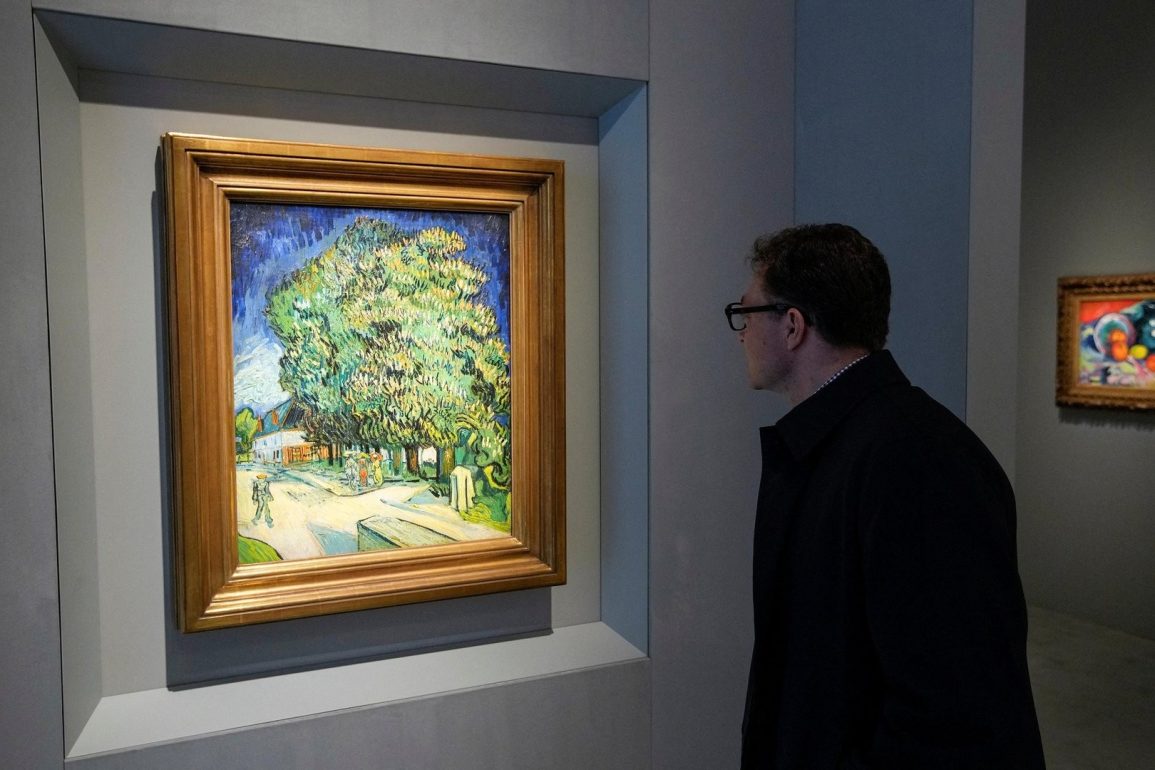
New York’s auction houses sold $2.44 billion of art in one week, and the big lesson wasn’t the record van Gogh: buyers paid up for safe, easy-to-love pictures with a story, and walked away from anything priced on hype.
Two and a half billion dollars in five days, and the people who run the market still can’t tell you who made money. According to The New York Times‘s Julia Halperin, Tim Schneider and Zachary Small, New York’s fall marquee auctions brought $2.4 billion in art sales, and a $190.4 million van Gogh fight stole the show. “This is it,” auctioneer Oliver Barker told a packed Sotheby’s salesroom on Wednesday, Nov. 18. “The moment of no return.”
According to Artnet‘s Richard Whiddington, the evening sales at Sotheby’s, Christie’s and Phillips totaled about $2.03 billion, a seven percent bump over last year’s $1.9 billion. Day sales added $406.1 million, for roughly $2.44 billion, up from $2.23 billion a year ago.
The scoreboard
Sotheby’s won the week with $1.2 billion from 136 evening lots, up about 18 percent, Artnet reported. Christie’s took $772 million, down around five percent. Phillips ran a tight 22-lot sale for $104.4 million, 55 percent better than last year.
The money was lined up early. According to The Art Newspaper‘s Carlie Porterfield, the houses went in expecting at least $2.04 billion, and possibly more than $2.4 billion, on the strength of big single-owner collections. Sotheby’s headliner, the Blaquier-Arrieta collection, was fully guaranteed and expected to make around $450 million. “Collectors today like to understand a narrative and see where works are coming from,” Sotheby’s Allegra Bettini told the paper.
Guaranteed before the doors opened
Here’s the part most people never see. The Times reported that Sotheby’s and Christie’s often promise sellers tens of millions of dollars up front to land the best works, sometimes even a cut of their own commission, and that well above $1 billion of the evening sales’ estimated value was as good as sold before anyone raised a paddle.
That gets expensive when bidders don’t show. About half the winning bids on the week’s eight-figure trophies came in under the high estimate, and the van Gogh itself hammered $15 million below expectations before fees, the Times reported. Artnet noted the Blaquier-Arrieta group hammered $56.5 million below its low estimate. “The prices all made sense, and in many cases, they are successes,” art adviser David Norman told the Times. “The financial machinations puzzle me.”
Andrew Massad of Massad Fine Art was blunter. “Guarantees were pushed to the edge of a cliff, and estimates followed suit,” he told Artnet. Adviser Lauren Bender said “aggressive estimates” warped how the sales looked from the outside, since many works sold on a single bid.
Safe pictures won
What did buyers want? Landscapes, flowers and boats. “It’s very conservative taste,” Bernard Lagrange of Gagosian Art Advisory told the Times. A small Andy Warhol flower painting made $6.1 million against a $3.5 million high estimate, while a bigger Warhol from his Fright Wig series was withdrawn at Christie’s, presumably for lack of interest. Buyers want images “that are easier to digest, that photograph well, that are uplifting,” Lagrange said.
A Claude Monet sailboat the size of a playing card brought $7 million, about 14 times expectations. Massad told Artnet the most energy was in the Impressionist and modern day sales: “the art your grandparents owned is the new New Now.”
Story sold too. Aaron Douglas’s 1931 painting Harriet Tubman, estimated at $2.5 million to $3.5 million, sold for $14.48 million at Sotheby’s, according to Black Enterprise‘s Ida Harris. The painting belonged to Bennett College, the historically Black women’s college in Greensboro, North Carolina, which is putting the money toward a women’s health initiative. Harris reported that some students and alumnae wanted the sale stopped.
Hype doesn’t hold
The Times ran the resale math, adjusted for inflation. A Kandinsky that sold for about $1 million in 1986 came back at $85.8 million. But a 2003 Richard Prince that sold for $3.4 million in 2008 made $3.9 million, a loss of about 26 percent in real terms, and a 1993 Ed Ruscha bought in 2017 lost about 9 percent. Seven works consigned by Jeff Koons were hoped to make up to $153.5 million and brought about $104.8 million.
Even Yayoi Kusama, who died in August, got a mixed report: a record $15.1 million for an early red canvas, but two sculptures went unsold, including a 2021 Starry Pumpkin. “It’s still not a market where you’re going to sell every painting on the wall just because it’s ‘art,'” UBS’s Matthew Newton told the Times.
The takeaway
You’re not selling a van Gogh, but the same rules work at your price point. Buyers paid up for work that’s easy to love, photographs well and comes with a clear story, and they walked away from anything priced on hype. Keep your prices honest, because a sold-out show at fair prices beats a wall of unsold work at dream prices. Write down your work’s story and its history, who made it, when and where it’s been, because provenance is now part of the price. And remember the Prince and Ruscha numbers: hot today doesn’t mean worth more tomorrow. Build collectors who buy because they love the work, not because they’re betting on it.
Image: The Business Times