


Rockstar Games turned Miami’s street art scene into part of its marketing for Grand Theft Auto VI, paying for free museum entry, real-life murals and a merch line built on artists’ in-game work.
The biggest video game of the year didn’t just copy Miami. It hired Miami’s artists.
According to The Art Newspaper‘s Douglas Markowitz, the massive marketing push for Grand Theft Auto VI has taken over Miami ahead of Art Basel Miami Beach, and the city’s art scene is “coming along for the joyride.” The game came out worldwide on Nov. 19. It’s set in Vice City, a satirical copy of Miami, with a neighborhood called Stockyard that stands in for Wynwood and its graffiti culture.
Ten murals, two worlds
On Oct. 13, the Wynwood Walls mural museum announced a partnership with Rockstar Games, the studio behind the game. According to ARTnews‘ Andy Battaglia, the museum unveiled 10 new murals created for the game’s fictional world, on the museum campus and around the neighborhood. The artists include ATOMIK, Tatiana Suarez, Askew One, DENIAL, FAILE, Gons and Audet, Lady AIKO, Queen Andrea, Ron English and Tristan Eaton. Other street and tattoo artists whose work shows up in the game were curated by 1XRUN, a creative agency based in Detroit.
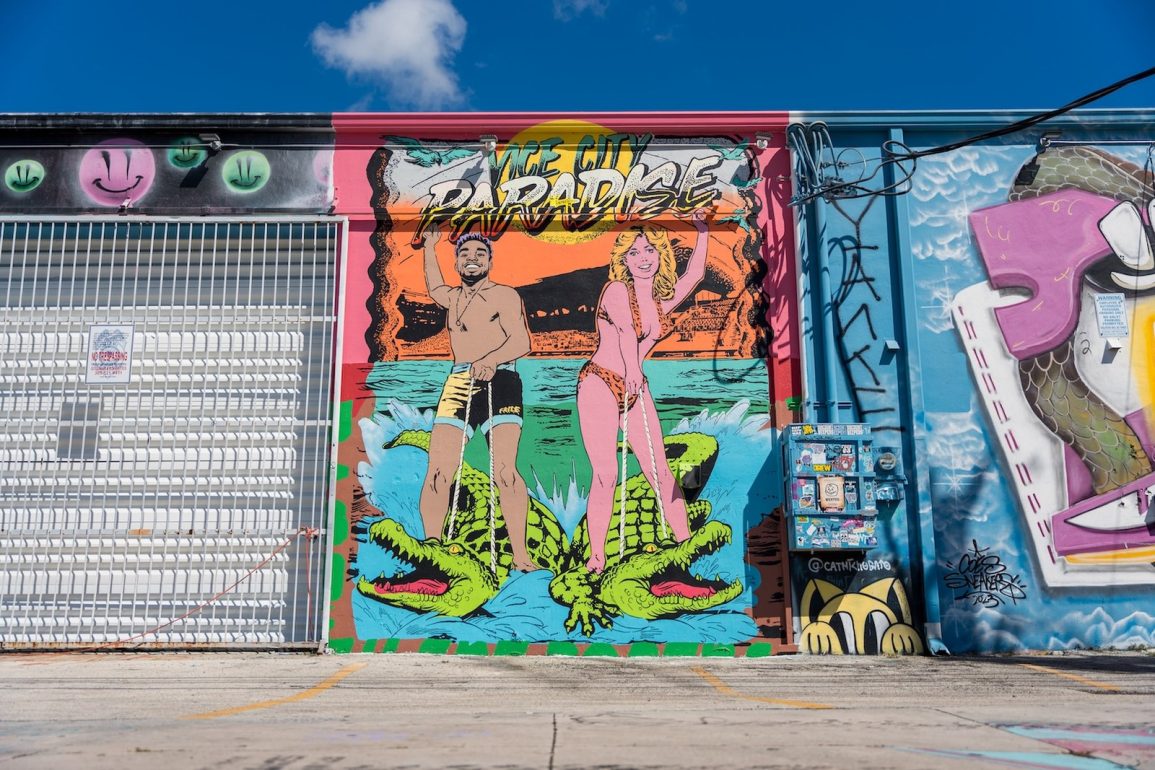
The real murals look a lot like the virtual ones. The Art Newspaper reported that Queen Andrea’s reads “Welcome to Vice City” in curvy, neon-style letters, while Ron English painted grenades shaped like lightbulbs with the line “There’s nothing more dangerous than a good idea.” According to the Miami Herald‘s Madeleine Marr, Brooklyn duo FAILE’s piece, “Vice City Paradise,” shows a man and a woman in bathing suits surfing on alligators. The murals stay up until Jan. 1, 2027.
The game itself goes much bigger. Wynwood Walls CEO and curator Jessica Goldman Srebnick told The Art Newspaper that Rockstar commissioned in-game murals from about 50 artists, many of whom have shown at the museum before. “Street art and gaming have a lot of shared cultural DNA, and they’ve influenced each other,” she said.
Free tickets and a merch drop
The deal comes with perks for locals. Miami-Dade County residents with a valid photo ID showing a county address get in free through 2028. The Herald reported that the 80,000-square-foot museum used to be free but started charging in 2021, after COVID, and visitors from outside the county still pay $12.
Then there’s the merch. According to Miami New Times‘ Osvaldo Espino, the museum launched a capsule collection based on in-game art by 15 artists, including shirts, caps, water bottles, flasks and keychains. It’s called “The Art of Vice City,” and it’s sold through the museum’s online shop.
Museums got the Vice City treatment too
Rockstar also rebuilt, and renamed, Miami’s art museums inside the game. The Art Newspaper reported that the Pérez Art Museum Miami became the “Future Leonida Art Museum,” the Wolfsonian design museum became the “Hicksonian Museum of Art and Design,” and Miami Beach’s Bass Museum of Art became the “Vice City Museum of Art.” The Bass’s well-known Ugo Rondinone sculpture Miami Mountain was turned into a giant stack of emojis.
All of it sits inside a much larger campaign. According to Miami New Times’ Allison Beck, Miami-Dade County signed a $3.9 million deal covering themed lighting at the airport and PortMiami, signs on airport walkways and wraps on traffic signal boxes. It also includes the $975,000 “Welcome to Vice City” display on the roof of the Kaseya Center, and the mayor’s office said that money is going to a long-promised park behind the arena.
Not everyone was cheering
There was a real cost on one wall. Espino reported in a later New Times story that one of the GTA murals, painted by Suarez, covered a memorial to the late graffiti artist Alex “Rect” Reyes, built around his last work after he died in a car crash in 2022. His mother, Myriam Rivera, said she got no advance notice. Suarez declined to comment, and Rockstar didn’t respond to the paper.
Goldman Global Arts, which produced the murals, said it offered Rect’s crew, DTK, a different wall and materials to make something new. Ariana Rosasco, a friend of Rect, said that doesn’t fix it. “The damage is done. The family’s hurt,” she told New Times. “It’s never going to be the same.”
The takeaway
Big brands now pay for culture they can borrow, and artists with a recognizable style are what they’re buying. Rockstar didn’t commission murals because it needed paint on walls. It needed credibility in Wynwood, and the artists brought it. Notice how the work kept paying off: art in the game, the same art on real walls, then on shirts and caps sold through a museum shop. If you land a brand deal, ask early about every place your work will show up, including merch, and get paid for each one. Build your name locally, too. Many of the artists Rockstar hired had already shown at Wynwood Walls before the call came. And remember the Rect wall. Respect in your scene is part of your brand, and walls carry history that a fat marketing budget can’t buy back.
Image: ARTnews